

Last November, we got depressed.
I was sitting around with friends: programmers, computational scientists, machine learning researchers, former lab mates. We had spent years getting good at our craft. Because we were among the first people playing with some of the latest models before release, we got to have this particular existential crisis a little ahead of schedule.
The model was better than us.
It knew software packages we didn’t know. It wrote cleaner numerical simulation code. Things we considered difficult, things we had taken private pride in being able to pull off, it could just do.
There we were, a room full of experienced people looking at one another and thinking the same uncomfortable thought: apparently we are no good at coding any more.
Our abilities hadn’t vanished overnight, of course. The comparison had changed. A surprising amount of adult identity gets welded to being the person in the room who knows how to do something hard. Then a piece of software knows how to do it too, before your coffee cools.
For about a month, we sat with that. Then, gradually, we started to climb out of it.
My own moment of enlightenment was almost embarrassingly simple.
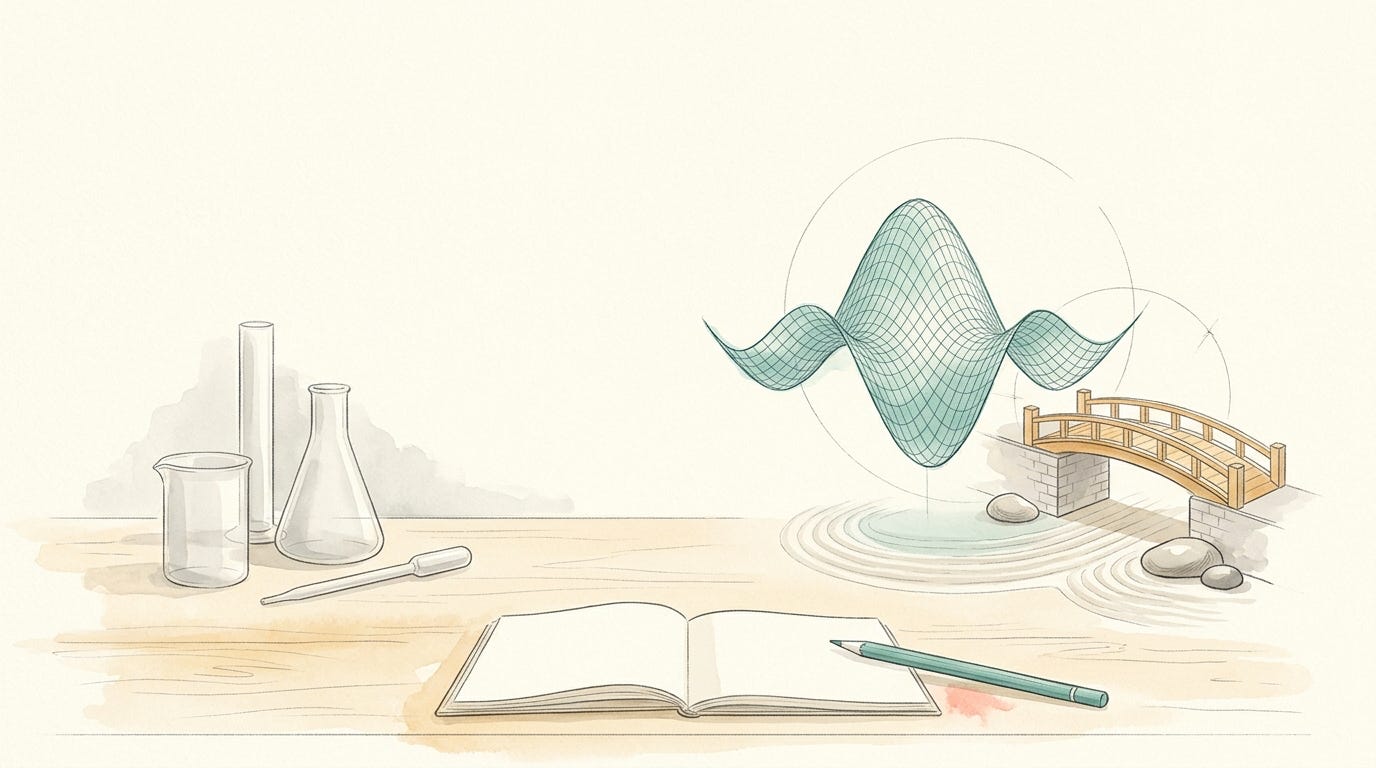
Computer science was never about writing the code, any more than chemistry was about the beakers and glassware.
Nobody gets into chemistry because they want to become the best person in the world at holding a beaker. You get into it because you want to understand how matter rearranges itself, or make a molecule that changes what happens inside a living cell.
Don’t mistake the process of how you accomplish something with the thing you wanted to accomplish.
They are not, and never were, the same. We just forgot.
Nobody falls in love with code in a vacuum. You see a result. Something moves on a screen. A simulation runs and shows you a behavior you didn’t expect. An idea becomes something another person can touch and poke at. Then you have an idea of your own, and you want to bring it into the world.
So you learn to code. You struggle. You curse the machine. You spend an unreasonable Tuesday evening figuring out why a matrix dimension refuses to align, learn three more libraries along the way, and eventually haul the idea across the finish line into reality.
Somewhere along that road, it becomes remarkably easy to get attached to all that struggle. You paid for the craft in hours and frustration. It belongs to you. Being good at it feels like proof that you deserve to be in the room.
I had become so attached to how I made things that I had briefly forgotten why I wanted to make them.
Once I remembered, the gloom lifted. Everything opened up again.
And then we went slightly mad. I suddenly wanted to “Build all the Things.”
Build all the Things
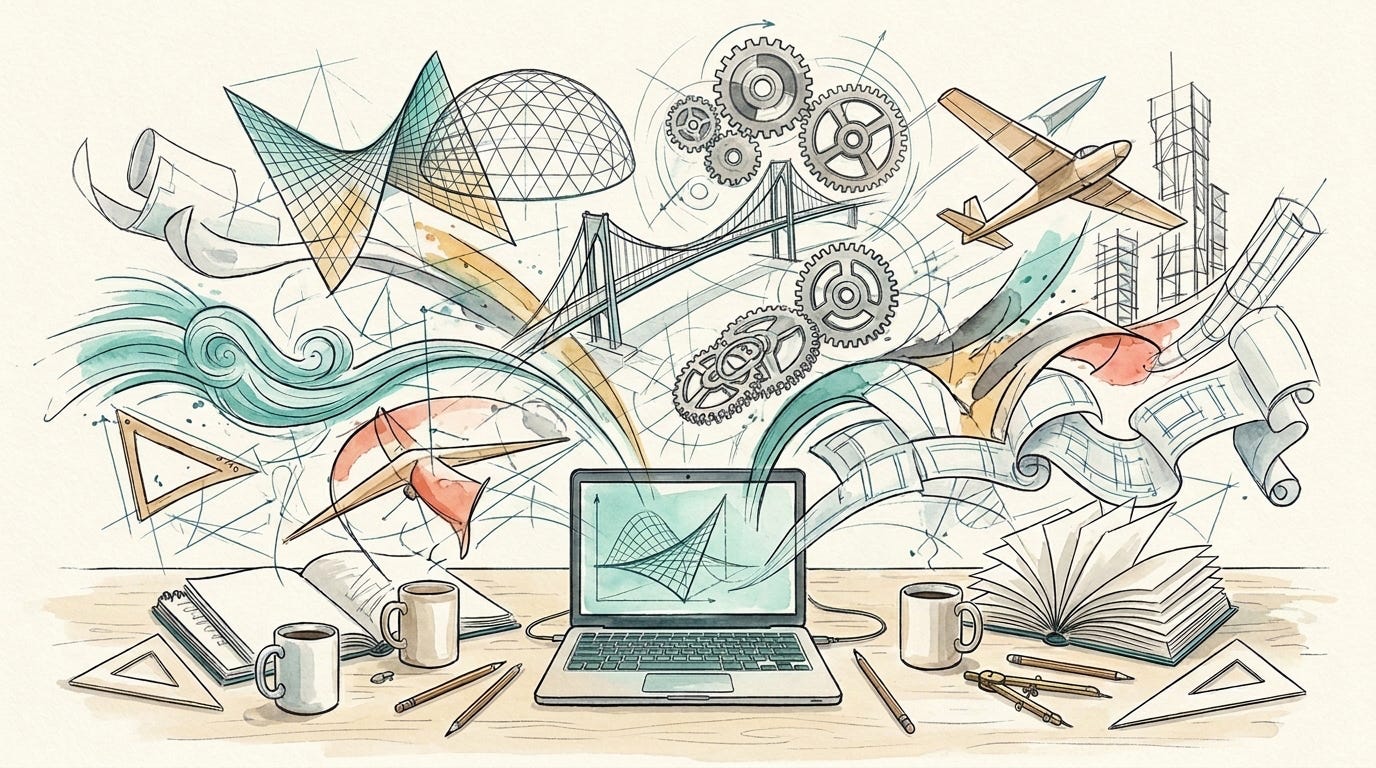
Having spent a month convinced we could no longer do anything, we collectively entered a phase I can only describe as AI psychosis.
We suddenly realized we could finally build all the ideas. Do all the things. Every half-formed project that had been sitting in the back of a notebook for five years, every weird tool you had wanted to try but couldn’t justify spending six months learning the framework to build, was suddenly on the table before lunch.
So you started.
Fifteen projects on the go. Token maxing. Sleeping four hours a night. Waking up at four in the morning because another idea popped into your head, and now there was zero practical reason to wait until daylight to see whether it might work. One more prompt. One more branch. One more prototype spinning up before breakfast.
It feels extraordinary for a few weeks. The distance between having a thought and watching something run on your screen shrinks so far that you keep crossing it just to feel the rush. Every time you step across, two more shiny ideas are waiting on the far bank.
Then you slam into the real wall.
You are the bottleneck.
You still have to decide what you actually want. You still have to read what came back, test whether it works under real edge cases, figure out whether the whole thing even makes sense, and decide whether you care enough to finish it. The machine can keep generating fresh branches until your billing alert screams. Your attention refuses to expand to match it.
There is an uncanny empirical echo of that four-in-the-morning feeling in software engineering itself. In July 2025, Joel Becker, Nate Rush, Elizabeth Barnes, and David Rein at METR published a randomized controlled trial tracking experienced open-source developers working on mature repositories they had maintained for an average of five years. When those developers were allowed to use early-2025 AI coding tools, they took 19 percent longer to finish their tasks than when they worked without them. The startling part was how it felt from inside the chair: beforehand, the developers predicted AI would cut their completion time by 24 percent, and even afterward they estimated it had cut their time by 20 percent (Becker et al., 2025).
To be fair to the tools, that trial measured early-2025 models on tangled, long-lived codebases rather than fresh prototypes, and models have improved substantially since then. Even so, the gap between the stopwatch and the feeling in your chest captures something real about this era. Generation feels like velocity. Reviewing, untangling, pruning, and deciding what deserves to stay is where the hours go. Or you just give up and pray to the gods of unit testing. My gosh, do we write so many tests these days. Remember when test coverage was a thing?
Worse still, human psychology already leans hard in the wrong direction when you sit tired in front of a machine that loves to say yes. In 2021, Gabrielle Adams, Benjamin Converse, Andrew Hales, and Leidy Klotz published a series of eight experiments in Nature spanning Lego structures, grid puzzles, travel itineraries, and text editing. When asked to improve an imperfect design, people systematically defaulted to adding new elements and overlooked simpler, superior fixes that required taking pieces away (Adams et al., 2021). When the researchers put participants under higher cognitive load, that blind spot grew wider. Adding is the fast heuristic your brain reaches for when it is tired. Subtraction takes deliberate extra work.
Now pair a sleep-deprived human running fifteen tabs at four in the morning with the most fluent addition engine ever constructed. Ask a language model to improve a draft, a codebase, or a research plan, and its natural instinct is to hand you two extra sections, three helper abstractions, and a dashboard nobody asked for. (I have yet to meet a model that replies, “Delete chapters two through four and go to sleep,” though I would happily pay double for that subscription.)
Somewhere in that exhaustion, a strange and slightly humbling thought arrives.
Maybe the old barrier was doing something useful.
I don’t miss the part where six months of boilerplate kept good ideas locked in a drawer. Yet that steep entry price also performed hidden editorial work for free. If building something meant giving up six months of evenings and weekends, you had to care about it enough to surrender six months of your life before you wrote line one. That cost and commitment meant you had to have conviction, or passion, or just really want to do it. Friction screened out the merely clever.
Now you can launch fifteen clever things on a Sunday afternoon without ever making that choice. (Yes, I appreciate the irony of someone using these tools to finally finish off a set of half-done essay ideas for my Substack, though in my defense I wrote this myself.)
Beginning is cheap, and caring is still expensive.
Just because you can build it doesn’t mean you should. (Oh, Jeff Goldblum, remembered for that one line in Jurassic Park.) You knew that already, obviously. Knowing it in theory before you can do everything feels entirely different from learning it at four in the morning surrounded by fourteen half-finished repositories.
Silicon Valley borrowed the easy half of Rick Rubin
Right around the time we were discovering this exact hangover, tech culture found a patron saint.
In February 2025, Andrej Karpathy coined “vibe coding,” describing a style of software work where “you fully give in to the vibes, embrace exponentials, and forget that the code even exists” (Karpathy, 2025). Almost immediately, memes across Silicon Valley cast music producer Rick Rubin as the spirit animal of the movement. By May 2025, Rubin leaned straight into the joke, releasing The Way of Code: The Timeless Art of Vibe Coding (Rubin, 2025).
It is easy to see why Rubin became the poster child. Two years earlier, in January 2023, Anderson Cooper interviewed Rubin on 60 Minutes at his Shangri-La studio in Malibu. The exchange has been clipped a million times across tech feeds, usually with triumphant captions:
Anderson Cooper: Do you play instruments?
Rick Rubin: Barely.
Anderson Cooper: Do you know how to work a soundboard?
Rick Rubin: No. I have no technical ability. And I know nothing about music.
Anderson Cooper: You must know something.
Rick Rubin: Well, I know what I like and what I don’t like. And I’m decisive about what I like and what I don’t like.
Anderson Cooper: So what are you being paid for?
Rick Rubin: The confidence that I have in my taste and my ability to express what I feel has proven helpful for artists. (Cooper, 2023)
Look at what happened when that clip hit an industry suddenly freed from writing syntax by hand. Everyone grabbed the first half of the quote. Bare feet. Beard. No need to touch the mixing board. Just describe the vibe and let the band play!
That reading turns Rick Rubin into permission for four-in-the-morning mania. It mistakes stepping away from the glassware for the whole job.
What people conveniently clipped out of that 60 Minutes interview was another part of the same segment, where Rubin noted that he sometimes calls himself a reducer instead of a producer. Describing his studio sensibility to Cooper, Rubin said plainly: “I like the idea of getting the point across with the least amount of information possible.” When Cooper asked whether that is what he is doing in a recording studio, listening to music and trying to strip it down, Rubin answered that it is to see “what is actually necessary. Getting it down to that essence to start with is really helpful in understanding what it is” (Cooper, 2023).
That is the half of Rick Rubin that ideas actually need.
Regularization for your ideas
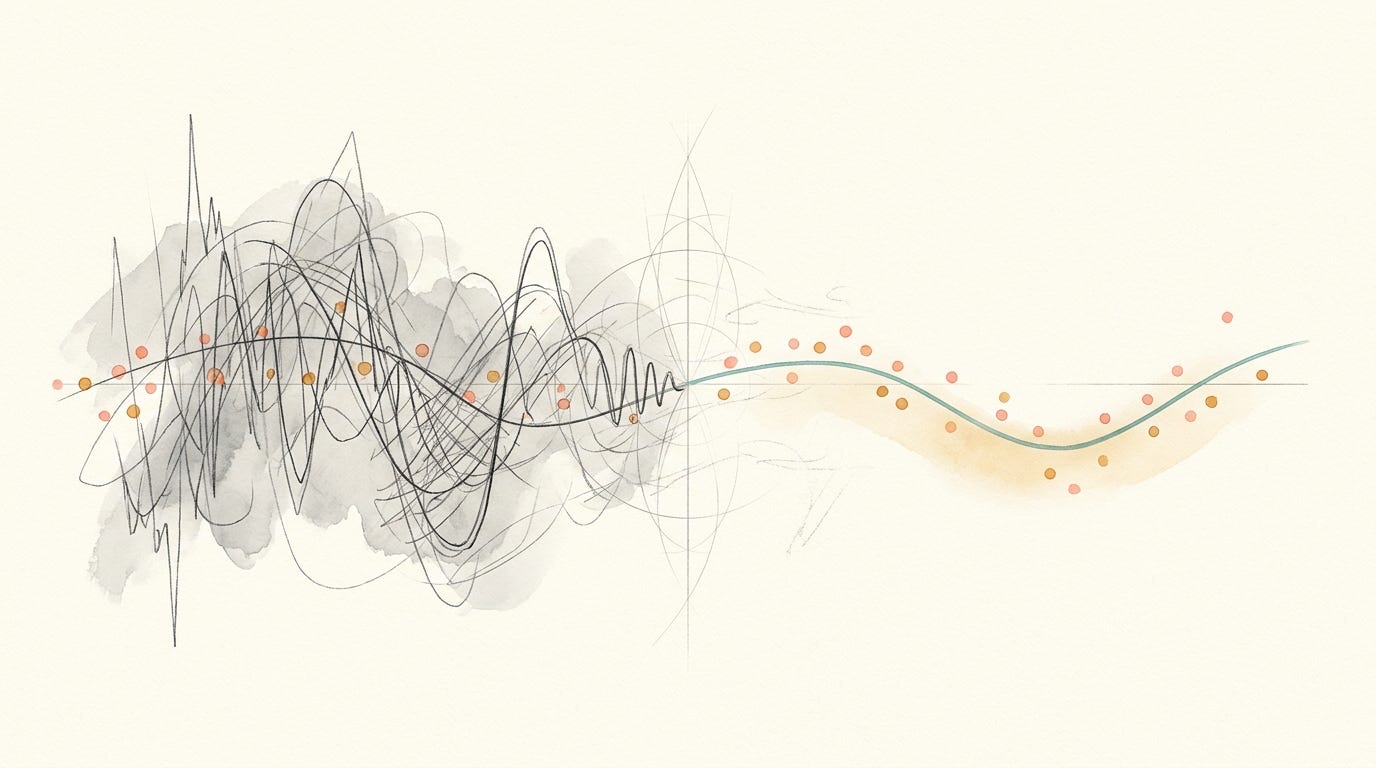
Anyone who grew up in machine learning already has a mathematical word for what Rubin is describing: regularization.
Before the field decided to solve every problem by just pushing the parameter counts higher, regularization was half the craft. When you give a model too many free parameters and zero penalty for using them, it chases every speck of noise in the room. Techniques like Robert Tibshirani’s 1996 Lasso put an explicit cost on complexity, shrinking unneeded weights straight to zero until only the sparse structure that actually generalizes survives (Tibshirani, 1996). We somehow forgot that instinct the moment scaling laws made adding more weights feel effortless, and we forget the exact human version of it the moment AI makes adding more code and more projects feel free.
In the early 1990s, Johnny Cash was treated by much of the Nashville establishment like a museum exhibit whose commercial clock had run out, his records buried in polite studio polish. When Rubin signed Cash to American Recordings, he applied a steep penalty to the whole arrangement. For American Recordings (1994), Rubin recorded Cash largely alone with an acoustic guitar, sitting in Rubin’s Los Angeles living room and in Cash’s cabin in Tennessee: no swelling strings, no busy backing band, no studio armor to hide behind. The record won the Grammy for Best Contemporary Folk Album the following year and launched the late-career run that redefined how generations hear Johnny Cash (Cash, 1994; Cash, 2002). (I now think Cash’s version of “Hurt” is better than Nine Inch Nails.)
If you have ever stared at an AI-generated prototype, essay draft, or research architecture, you already know how rarely that kind of subtraction happens by accident. The model wants to pad the arrangement with polite hedging, extra configuration flags, redundant abstractions, and three clever analogies where one true image would have done the work.
None of this reduction is fast, and that is the paradox that trips people up in the age of instant output. In December 1656, closing the sixteenth of his Provincial Letters, Blaise Pascal apologized to his readers with a sentence that has survived nearly four centuries because every writer eventually rediscovers it the hard way: he had made the letter longer only because he had not had the leisure to make it shorter (Pascal, 1656).
Compression costs more human attention than expansion. Generating five thousand fluent words or five thousand lines of working code now takes minutes. Deciding which four hundred words actually move the thought forward, or which tiny piece of software solves a real problem without dragging six fragile dependencies behind it, still takes your full mind.
The creativity of mania and careful reflection
Before we canonize restraint and print “be Rick Rubin” on coffee mugs, there are two legitimate places where four-in-the-morning mania genuinely outperforms careful reflection.
First, in closed-loop problems with an objective automated oracle (compilers, formal theorem provers, benchmarked numerical kernels, or exhaustively unit-tested parsers), firing off a thousand candidates overnight and letting a deterministic verifier throw away 99.9 percent of them beats slow human pruning every day of the week. In those domains, human judgment moves upstream to defining the specification and the test harness, while volume handles the search. Second, a short burst of reckless parallel prototyping can be the cheapest empirical experiment available: sometimes you only discover which single project deserves six months of your life by spinning up four rough sketches on a Saturday and watching three of them die on contact with reality. Open-ended creative, architectural, and scientific problems rarely come with a clean automated loss function once you leave those narrow loops, which is where careful reflection has to step back in.
Even inside that editor’s chair, though, the Rick Rubin image can mislead you. Reduction requires reading closely and doing real work, because you can’t do reduction via vibes.
The second trap is taste without enough technical skill.
Yes, chemistry was never about holding a beaker, and computer science was never about memorizing syntax. Yet a chemist who has no idea what a runaway exotherm smells like, or a physicist who cannot look at a simulation plot and notice that energy is leaking out of a closed system, is in serious trouble the minute an AI hands back a beautiful chart built on broken assumptions. (I wrote separately about how plausible, fluent errors scale in scientific work in Science slop at scale.)
You can stop holding the glassware without forgetting how to tell when the reaction has gone sour. Rick Rubin’s best records depended on one precondition that vibe-coding memes almost always erase: Johnny Cash and the artists walking into that studio were extraordinarily skilled musicians who knew every bolt of their instruments. Taste works when deep craft is still somewhere in the room, either inside your own head from years of practice and experience, or in the person sitting across from you who can tell when the work is broken before it ships.
So maybe the real danger is that calling ourselves Rick Rubin flatters our laziness. If we treat “taste” as a mystical vibe that excuses us from checking the math, testing the code, or staying present through the tedious final ten percent, we end up shipping bloated work from the couch and wondering why nobody trusts it. It is real work to be a scientific Rick Rubin.
The editor returns

If you are lucky, before any of that turns permanent, you simply burn out.
You stop waking up at four in the morning to fire off one more prompt before breakfast. You close fourteen tabs. You chill the hell out.
For a week or two, the half-built projects sit there on your drive, untouched. Something surprisingly clarifying happens in the silence. Most of them lose their shine completely once the adrenaline drains away. A project that felt urgent at 4:15 AM looks, in flat Tuesday afternoon light, like a neat trick nobody actually needs.
One or two of them don’t go away. They keep tapping you on the shoulder when you are making coffee or walking the dog. Those are the ones worth hearing out.
You start listening to that signal again.
Slowly, the editor returns. The part of you that can look at something you could effortlessly generate in an afternoon and say: leave it. Let an idea stay an idea. Put this clever feature back in the drawer. Strip the arrangement down to the acoustic guitar and see if the melody still holds when the room is empty.
You can hear yourself think again, and you can stay with one idea long enough to discover what it actually needs.
Raw ideas were never scarce, and now half-built prototypes aren’t scarce either. What remains rare is the calm willingness to cut fourteen plausible beginnings so that one true thing gets your full attention, your technical rigor, and your patience all the way to the end.
Then you come back to the desk. You stop and reflect. If you are anything like me, you get angry at the amount of “glop” an LLM proposes, and you yell at it. No, stop. All you need is this. Focus. The editor returns, and you build something with real impact in your field and your small part of the world.
Author’s note: I used tailored research and adversarial editorial review workflows to verify the interview transcripts, recording histories, psychological studies, and empirical software productivity citations, while writing from my unpublished drafts and creating the final essay and argument myself. LLMs are a great editor.
References
Adams, Gabrielle S., Benjamin A. Converse, Andrew H. Hales, and Leidy E. Klotz (2021). “People systematically overlook subtractive changes.” Nature, 592, pp. 258 to 261. https://doi.org/10.1038/s41586-021-03380-y
Becker, Joel, Nate Rush, Elizabeth Barnes, and David Rein (2025). “Measuring the Impact of Early-2025 AI on Experienced Open-Source Developer Productivity.” METR, arXiv:2507.09089. https://doi.org/10.48550/arXiv.2507.09089
Branson, Kim (2026). Science slop at scale, or how I learned to stop worrying and embrace the SME. LinkedIn, June 2026. https://www.linkedin.com/pulse/science-slop-scale-how-i-learned-stop-worrying-embrace-kim-branson-k07pc/
Cash, Johnny (1994). American Recordings (produced by Rick Rubin). American Recordings, released April 26, 1994; Grammy Award for Best Contemporary Folk Album, 37th Annual Grammy Awards (1995).
Cash, Johnny (2002). American IV: The Man Comes Around (produced by Rick Rubin; includes “Hurt,” written by Trent Reznor). American Recordings / Lost Highway, November 2002.
Cooper, Anderson (2023). “In Shangri-La with music producer Rick Rubin.” 60 Minutes, CBS News, January 15, 2023. https://www.cbsnews.com/news/rick-rubin-shangri-la-music-producer-60-minutes-2023-01-15/
Karpathy, Andrej (2025). Post on X introducing “vibe coding,” February 2, 2025.
Pascal, Blaise (1656). Lettres provinciales (Letter XVI, December 4, 1656; trans. A. J. Krailsheimer, The Provincial Letters, Penguin Classics, 1967).
Rubin, Rick (2025). The Way of Code: The Timeless Art of Vibe Coding (in collaboration with Anthropic), launched May 2025.
https://www.thewayofcode.com/
Tibshirani, Robert (1996). “Regression Shrinkage and Selection via the Lasso.” Journal of the Royal Statistical Society: Series B (Methodological), 58(1), pp. 267 to 288. https://doi.org/10.1111/j.2517-6161.1996.tb02080.x
Sources checked November 25, 2026.