

Language comes out of the mouth in a line because mouths are dreadful at parallel processing.
One mouth, one principal acoustic stream. No tabs. No split screen. No convenient ability to utter the subject, its qualification, the evidence, and the emotional commentary simultaneously, although certain committee chairs I known have made brave attempts.
Thought is less obliging. An idea arrives with causes, analogies, doubts, remembered examples, and comments about the wisdom of having the idea at all. It resembles a city map drawn by someone who has recently discovered overpasses. Yet an ordinary sentence asks us to take this tangle of relationships and deliver it in an order.
That creates an engineering problem: how do you transmit something with many connections through a channel that largely permits one thing after another?
Language gives the listener clues for rebuilding the connections. Word order, grammar, punctuation, and tone help turn a sequence into something another mind can understand.
Parentheses make this operation unusually visible. They open a passage out of the main sentence, take the reader somewhere related, and promise to bring them back. Sometimes the excursion occupies six words. Sometimes the author establishes a small independent government inside it.
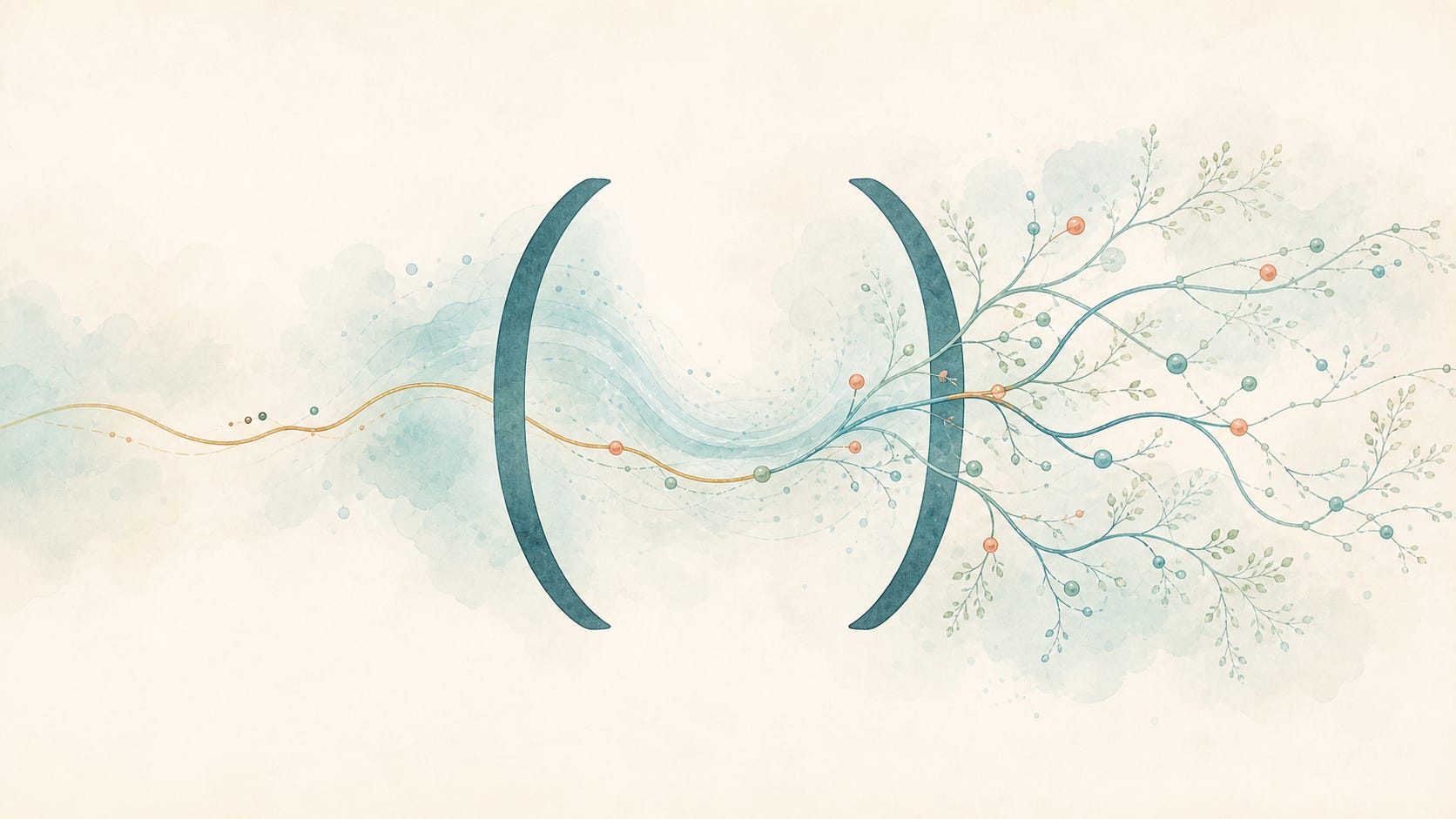
This is the sense in which parentheses are wormholes: two modest curves can open onto considerably more space than the surrounding sentence appears to contain.
A sentence is a route through a thought
Imagine explaining why an experiment failed. The explanation involves an instrument, a calibration error, a misleading result, an earlier assumption, and someone who has already booked the conference presentation. These things are connected, but you cannot say them all at once. You choose where to begin and which relationship to reveal next.
We can call the underlying arrangement a graph: a collection of things and the connections among them. That is a useful model of the communicative problem, rather than a claim that every thought begins as a finished diagram somewhere in the brain. Writing often helps us discover the relationships we are trying to express.
The rough operation is simple:
Connected ideas → words in an order → connections reconstructed by a reader.
The reconstruction is approximate. This is why civilization invented clarification, literary criticism, and the sentence “That is not remotely what I said.”
The words nevertheless carry routing information. Consider:
The surprisingly patient fly avoided the rolled newspaper.
“Surprisingly” modifies “patient.” “Rolled” belongs to “newspaper.” The fly does the avoiding. The reader groups words into phrases and establishes relationships between those phrases as the sentence unfolds.
Intracranial recordings have found patterns of neural activity consistent with the incremental building of phrase structure. Researchers still debate how much comprehension depends on explicit hierarchy, learned sequential regularities, or their interaction. The graph metaphor does not resolve those debates. It draws attention to the relationships comprehension must recover. See Nelson and colleagues’ study of phrase building and Frank and Christiansen on hierarchical and sequential processing.
“The dog bit the man” and “The man bit the dog” contain the same ingredients. Their arrangement tells us which participant did what. The order matters because it helps specify the connections.
Grammar is a graph construction protocol disguised as a parade of words.
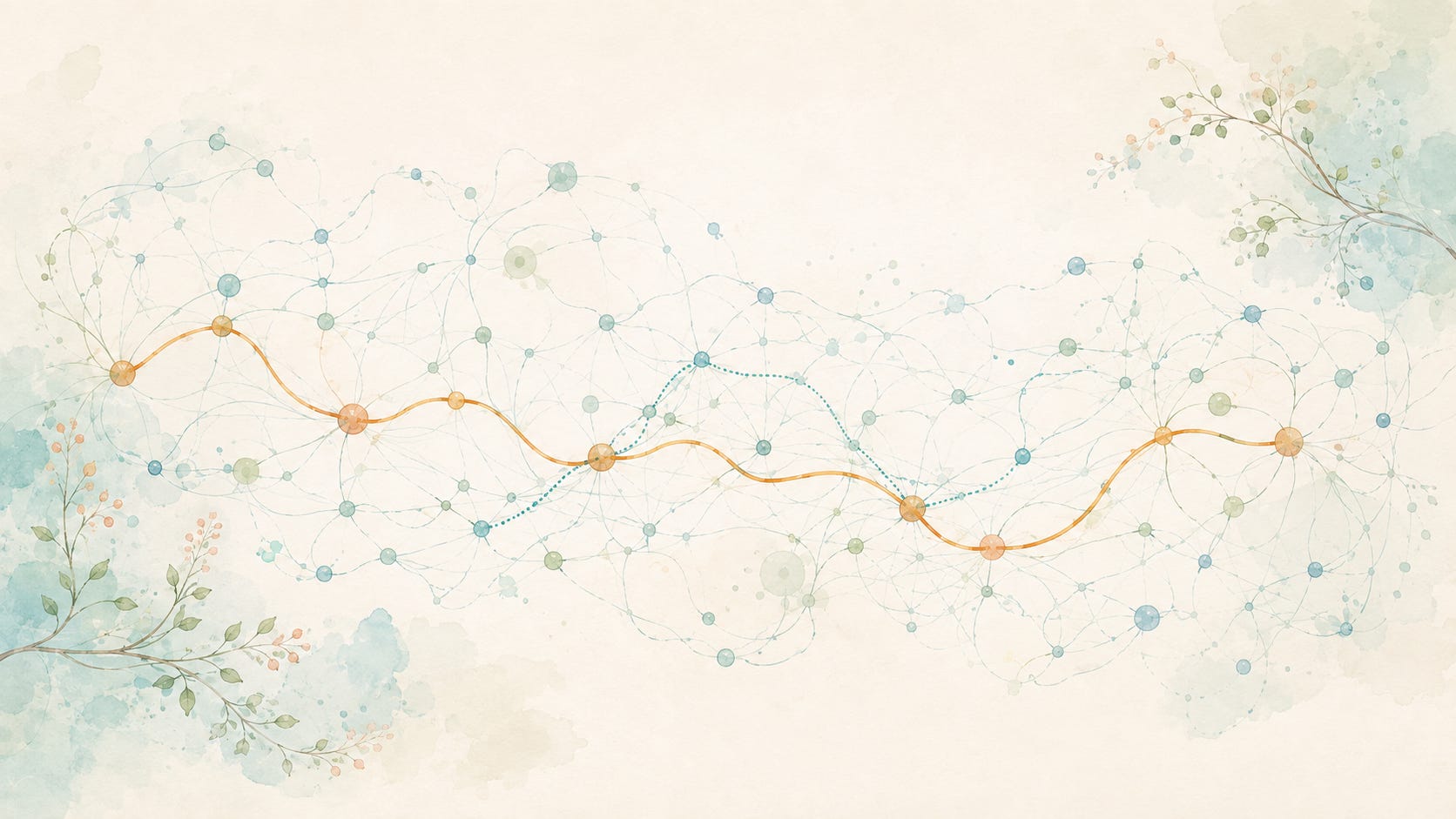
A sentence is one selected route through a larger structure of relationships.
Enter the parenthesis
Consider:
The experiment succeeded (although “succeeded” is doing rather more work here than the assay did) on the third attempt.
The main path is easy to recover:
The experiment succeeded … on the third attempt.
The aside suspends that path and attaches a qualification to “succeeded.” The reader must process the qualification while remembering that the host sentence has unfinished business.
The punctuation offers something like this instruction:
Save your place. Enter the branch. Process the commentary. Return to your place. Continue as though nothing happened.
The final instruction is frequently optimistic.
Computationally, this resembles a stack: a way of storing unfinished business so the most recently opened item is handled first. Open an aside inside an aside, and you are expected to close the inner one before returning to the outer one.
Main claim (first qualification [qualification of the qualification] return to first qualification) return to main claim.
This is orderly recursion. It resembles borrowing a car, then borrowing a bicycle while using the car, returning the bicycle, and finally returning the car. Nested parentheses are recursion wearing office clothes.
The stack is an analogy for the reading task, not a claim that punctuation operates a literal stack in the brain. It captures the practical demand: remember where you left something incomplete.
Linguists have long noted the odd position of parentheticals. They occur inside a host utterance while often behaving as partly independent units. In speech, pauses or changes in pitch can help mark that independence, though there is no single pattern for every aside. See Dehé and Kavalova’s introduction to parentheticals.
The aside sits inside the sentence while seeming to stand a little apart from it.
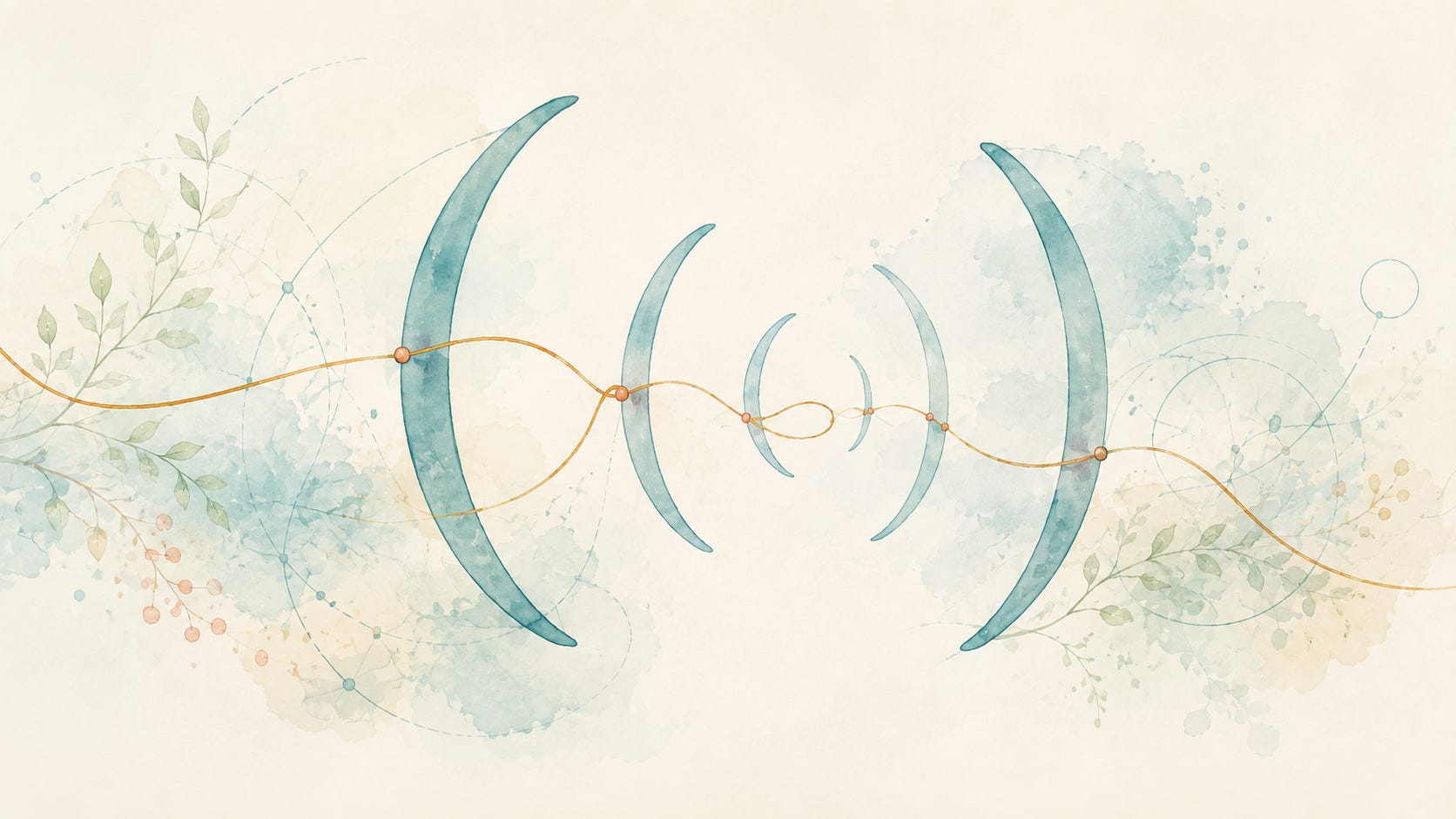
Every new aside opens another place from which the reader must eventually return.
The narrator steps onto a balcony
That slight separation gives parentheses much of their expressive power.
Compare:
The committee approved the proposal.
with:
The committee approved the proposal (God knows why).
The host sentence reports an event. The aside reveals the speaker inspecting the event with concern. We have moved from the described world to the narrator’s attitude toward it.
Parentheses create a little balcony from which the author leans toward the reader. Dashes can perform a similar move with more drama—parentheses whisper, dashes burst into the room carrying documents. A footnote opens a trapdoor. A hyperlink installs public transport.
An aside can also change how seriously we should take an assertion:
The model worked (or, more precisely, it failed in an informative way, which in research is often reclassified as working).
The parenthetical revises “worked,” qualifies the claim, and tells us that the writer knows the original wording was suspicious. It supplies information about how to interpret the assertion.
Readers track these shifts almost without noticing. We distinguish what happened from what someone claims happened; confidence from doubt; a character’s belief from the narrator’s endorsement. Quotation adds another speaker. Irony asks us to infer a stance that the literal wording may conceal.
The sentence can contain several perspectives, each attached to a different person or level of narration. Much of the pleasure of an aside comes from briefly meeting the writer at one of those other levels.
Beyond the sentence, branches reconnect
Nested parentheses give us a tidy branching structure. A paragraph can establish connections that refuse to stay tidy.
Consider:
The experiment failed on Monday. The team repeated it on Tuesday. That changed their interpretation of the original result.
What does “That” refer to? The act of repeating the experiment? The outcome of the repetition, which has not been stated? Something learned by comparing the two attempts?
The word appears beside one sentence, but its interpretation may depend on an event assembled from several pieces. The final sentence also reaches backward: it changes how we understand Monday.
A tree gives each branch a single parent. Discourse often allows a passage to participate in several relationships at once. One sentence can explain a result, contradict an expectation, and qualify an earlier claim. Wolf and Gibson argue that connected graphs capture some of these relationships better than strict trees in Coherence in Natural Language.
We can therefore read the same paragraph through several overlapping structures: who or what each expression refers to, which events caused others, which claims support or contradict one another, and who believes each claim.
Parentheses reveal a local branch. Reference, explanation, and revision connect the branches across the rest of the text.
This is why reading sometimes changes a sentence we have already finished. Its words remain in place. Its connections have changed.
The memory bill eventually arrives
All these detours cost something.
The paper that the reviewer whom the editor selected criticized was withdrawn.
The sentence is grammatical. It is also what language would look like if designed by a filing cabinet during an earthquake.
The paper needs its main verb. The reviewer needs to do something to the paper. The editor selects the reviewer. The reader must keep those relationships available until the relevant words arrive.
Research on parsed text from 37 languages found that syntactically related words generally occurred closer together than expected under randomized comparison orders. This tendency, which is called dependency-length minimization, supports the idea that language is shaped partly by the costs of keeping related elements separated. It is a tendency, not an strict law. See Futrell, Mahowald, and Gibson’s study.
Models that treat memory as limited and lossy likewise help explain some difficulties with recursive sentences. A reader has to use available memory efficiently, rather than preserve every earlier word with archival fidelity. See Hahn and colleagues’ resource-rational model.
A parenthesis asks for a similar loan. The reader holds the main sentence open while attending to the aside. If the excursion becomes long enough, the writer may need a recovery beacon:
The central result—which emerged only after the calibration error was corrected, the assay repeated, and the switched control samples discovered—the central result was robust.
The repetition sounds clumsy, but it performs a service. The writer has wandered into the forest and is shouting the name of the original trail.
A short aside can save effort by attaching a necessary correction exactly where it belongs. It prevents the reader from carrying the wrong interpretation into the next paragraph. But the qualification must earn the interruption. One aside is usually affordable. Four nested asides and the reader’s parser starts unionizing. I have found myself matching closing parenthesis on more than one occasion in my writing.
For a writer, the practical question is whether the reader needs this branch now. A caveat that changes the meaning of “succeeded” belongs close to that word. A history of the assay may deserve its own paragraph. An interesting detail can wait in a footnote.
The connections can remain rich while the route becomes easier to follow.
Language cheats whenever it can
The line is only part of the interface anyway.
Pitch, rhythm, stress, and timing travel alongside spoken words. Gesture adds another channel. Facial expression adds another. A speaker can say “the fish was this big” while the hands provide the only quantitative data.
Sign languages make simultaneous communication especially clear. Hands, facial expression, head movement, and posture can convey coordinated information at the same time. They also have sequential structure and constraints on how much can overlap; simultaneity is a resource with limits. See Loos, German, and Meier on simultaneous structures in sign languages.
Writing uses space. A reader can glance back, scan headings, inspect a diagram, or descend into a footnote. Indentation and typography help distinguish levels. Mathematical notation places relationships above, below, and around one another. Even this essay’s illustrations offer a way to inspect several connections at once.

A footnote opens a trapdoor. A hyperlink offers another route through the material.
Hypertext makes the invitation explicit: there is something related elsewhere, and you may follow the connection.
The web is what happened when footnotes escaped containment.
A digital essay can offer an argument that unfolds in order, with evidence, qualifications, and derivations available at greater depth. Different readers can take different excursions. But the author still has to recommend a route. If every branch is equally prominent, the reader inherits the job of deciding what matters next.
Sequence creates emphasis, suspense, and argument. Choosing what comes first is part of saying what something means.
Machines face a related problem
Transformers provide a useful mechanical analogy. They process ordered tokens, while self-attention allows a representation at one position to draw on information at other permitted positions. The original transformer architecture makes these relationships explicit in its computation. See Vaswani and colleagues’ “Attention Is All You Need”.
Researchers have also recovered information corresponding to syntactic trees from contextual word representations in models such as BERT. That does not establish that a model holds one pristine symbolic tree or that its attention weights explain its reasoning. It shows that representations learned from sequences can encode structural relationships. See Hewitt and Manning’s structural probe study.
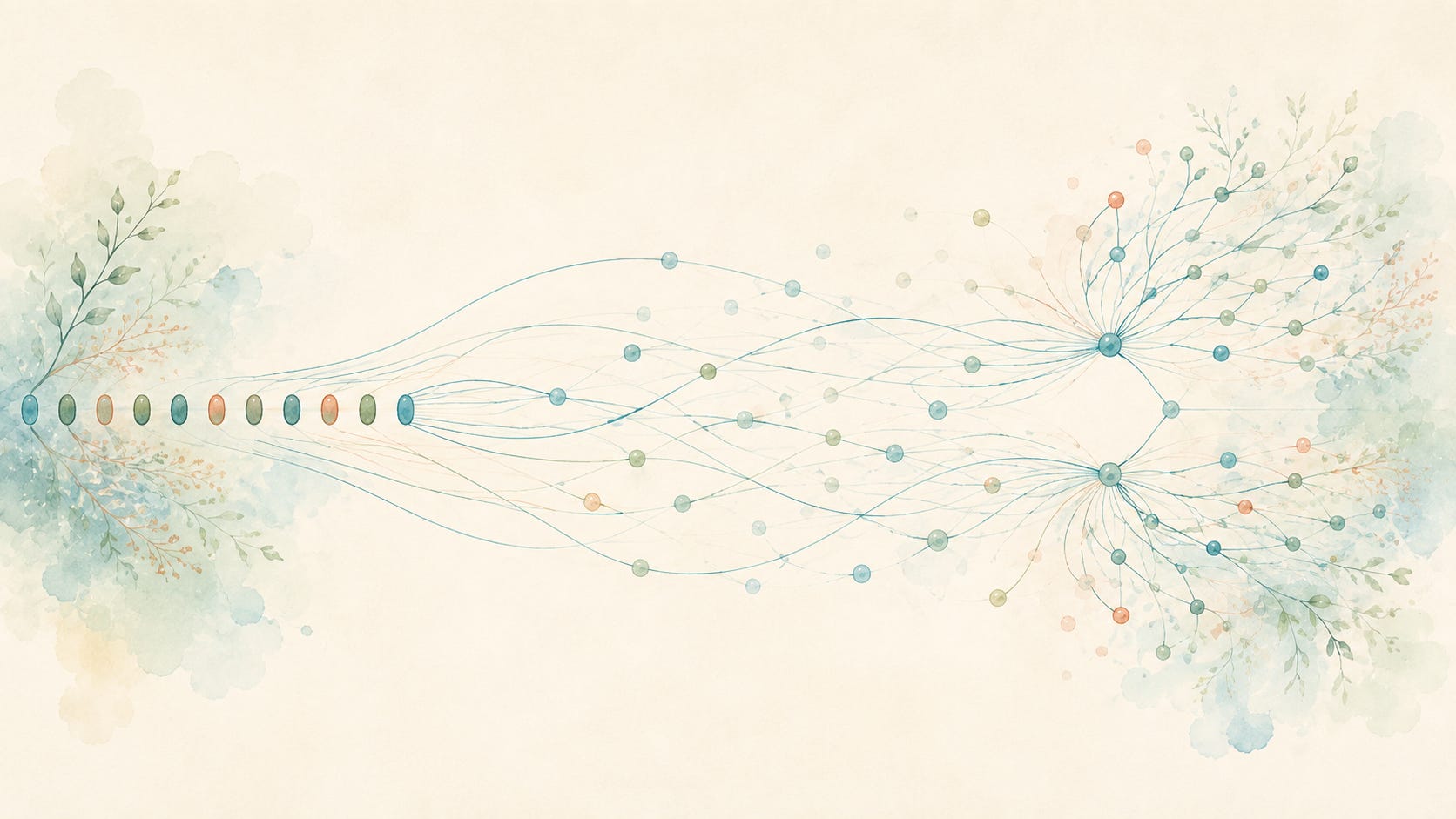
A conceptual illustration of relational computation over sequences, rather than a literal diagram of a model’s thoughts.
The analogy has a limit. A language model need not begin with a completed thought that it subsequently translates into words. Its computation continues as it generates. But a familiar pressure remains: a text answer must present its material in an order, even when understanding it involves many relationships.
That offers a way to describe two recognizable prose styles, without pretending to diagnose their computational cause. One presents a route so polished that uncertainty seems to have vanished. The other surfaces every qualification until the main claim disappears beneath the commentary.
Human writers face the same editorial choice. A clean sentence hides much of its construction. A parenthetical leaves a junction visible.
The return matters
Parentheses expose a small piece of what reading asks us to do. Save an unfinished thought. Visit a related one. Notice a change in confidence or voice. Return with a slightly different understanding of the sentence we left.
They can preserve the shape of thinking at the moment it happens: the correction beside the claim, the doubt beside the confidence, the author’s raised eyebrow beside the official account. Used well, that proximity gives prose precision and intimacy.
Used too enthusiastically, parentheses allow a sentence to annex neighboring territories until the full stop becomes a ceremonial institution.
Good writing requires deciding which connections to reveal, in what order, and at what cost to the reader’s memory. Sometimes the route is a straight road. Sometimes it needs a branch. Sometimes the aside is the real destination and the main sentence is merely the bureaucratic corridor required to reach it.
A sentence is a walk through a thought. A parenthesis lets us step off the path together.
The words arrive in a line but underneath, everything interesting has edges.
I would like to subscribe- how much $$&?