


A cleanly drafted circuit can obey every local rule of the diagram and still fold into a physical impossibility. Biology is full of targets that pass our grammar and fail in patients.
1. Is “colorless green ideas sleep furiously” actually meaningless?
I keep coming back to an old sentence from linguistics: “Colorless green ideas sleep furiously.” Read it once and notice what actually happens in your head. The sentence parses effortlessly. Every grammatical rule passes, and nothing trips at the level of word order or sentence structure. Then you actually think about what it is claiming, and the whole thing collapses. Why does a sentence fit every formal rule and still fail the instant your brain tests it against the real world? How does your mind run that falsification check in less than half a second? And what does that seventy-year-old puzzle have to do with why roughly seven in ten drugs entering Phase II clinical trials fail in patients?
Noam Chomsky first printed that five-word string in 1956 (IRE Transactions on Information Theory, page 116) and made it famous a year later in Syntactic Structures (1957, pages 15 to 16). He wanted to separate grammatical form from real-world meaning. “The notion ‘grammatical’ cannot be identified with ‘meaningful’ or ‘significant’ in any semantic sense,” he wrote, placing two sentences side by side:
Colorless green ideas sleep furiously.
Furiously sleep ideas green colorless.
Put both next to keyboard noise like "bglk zq freen". Noise gives your mind nothing to grip. Sentence (2) uses real English words, yet breaks down right away because you cannot assemble a parse tree without scrambling the order. Sentence (1) obeys every rule of English syntax: two adjectives modify a plural noun serving as the subject of an intransitive verb modified by an adverb. Nothing fails at the rule-checking stage. Your mind builds the grammatical frame effortlessly, hands you a legible proposition, and then watches that proposition crash into reality.
Roman Jakobson noticed that exact point right away. Writing in 1959, he pushed back on calling sentence (1) meaningless. If a string were truly meaningless, you would have no basis for calling it true or false. Because sentence (1) parses and follows the rules, you know what claim is being asserted, which is the very reason your mind can test it against the world and judge it literally false (or stretch it into metaphor). Try doing either with "Furiously sleep ideas green colorless" and you hit a wall before meaning even enters the room.
Chomsky made a second claim on those same pages that speaks straight to modern AI in biology. Because “neither sentence (1) nor (2) (nor indeed any part of these sentences) has ever occurred in an English discourse,” he argued that “in any statistical model for grammaticalness, these sentences will be ruled out on identical grounds as equally ‘remote’ from English.” He had simple surface Markov models in mind, systems that only count exact word sequences seen in past text.
In 2000, Fernando Pereira tested that claim by training a smoothed latent-class Markov model on newspaper text. Neither five-word string appeared in training, yet by grouping words into latent distributional classes from surrounding context, Pereira’s model gave sentence (1) roughly 2 × 10⁵ times higher probability than sentence (2). Statistical models trained purely on sequences really can learn syntax once they discover latent structure, much as modern protein and genomic models learn molecular syntax. What neither grammatical rules nor sequence statistics test is whether a legal sentence actually holds true in the physical world.
So if formal grammar and sequence statistics both wave “Colorless green ideas sleep furiously” right through, what catches it inside a human head?
From intuition alone, you might picture language comprehension as a tidy two-step assembly line. Step one: a fast language module checks syntax and opens a mental dictionary to verify that word definitions fit together. Step two: only after clearing that dictionary check does a slower reasoning system consult factual knowledge about the real world.
Cognitive neuroscientists tested that two-step picture using scalp EEG, tracking cortical voltage millisecond by millisecond. Earlier experiments had mapped two classic waves: broken grammar and tangled sentence structure tend to evoke a late positive shift around 600 ms called the P600 (tracking structural repair broadly, beyond pure syntax alone), while clashes in meaning trigger an earlier negative deflection around 400 ms called the N400 (first described by Marta Kutas and Steven Hillyard in 1980).
In 2004, Peter Hagoort and colleagues ran an EEG and fMRI study in Science to separate dictionary definitions from everyday world knowledge. Dutch volunteers read three versions of a plain sentence:
True: “The Dutch trains are yellow and very crowded.”
World-knowledge violation: “The Dutch trains are white and very crowded.” (Grammatically fine and conceptually plausible, except Dutch national trains are famously yellow.)
Semantic violation: “The Dutch trains are sour and very crowded.” (A lexical-category clash, since trains have no flavor.)
Under the tidy two-step model, “sour” should trip the N400 earlier than “white”, because checking a mental dictionary ought to happen before checking memory about Dutch rail colors. That is not what happened. Both “sour” and “white” produced an N400 with the exact same onset (around 300 ms) and peak latency (around 400 ms) across the 300 to 550 ms analysis window, and both lit up the same integration hub in the left inferior prefrontal cortex (Brodmann areas 45 and 47) on fMRI.
There is real nuance in Hagoort’s data: the N400 effect was stronger for “sour” than for “white”, and EEG rhythms split (theta power rose for semantic errors, while frontocentral gamma power rose for world-knowledge errors). Even so, the underlying mechanism is clear. Your brain has no sealed dictionary sitting upstream of reality. The instant a parsed sentence hits the N400 system, your brain’s active predictive world model steps in and falsifies it on one 300 to 400 ms clock (Kutas and Federmeier, 2011). Grammar lets “Colorless green ideas sleep furiously” through the gate; your world model rejects it on contact.
That raises a natural puzzle: if we carry a 400-millisecond reality detector right inside our prefrontal cortex, why do humans still get pulled in by fluent nonsense?
Part of the answer shows up if you sit with Chomsky’s sentence for ten seconds after the initial N400 clash. Humans hate leaving a well-formed grammatical frame broken, so we start bending definitions to salvage it: colorless softens into dull, green shifts to naive or newly sprouted, sleep turns into lying dormant, and furiously becomes simmering with volatile energy. Suddenly you have a moody remark about bland, half-formed ideas waiting to erupt. Linguists call this reflex meaning coercion. Poets have played with it ever since. In 1971, American poet and literary critic John Hollander folded Chomsky’s exact line into “Coiled Alizarine (for Noam Chomsky)” in The Night Mirror:
Curiously deep, the slumber of crimson thoughts:
While breathless, in stodgy viridian,
Colorless green ideas sleep furiously.
Two lines of surrounding imagery are all it takes for the sentence to feel deliberate. In 2020, Emily Bender and Alexander Koller turned that listener reflex into a vivid thought experiment, the Octopus Test. Picture two humans stranded on separate islands chatting over an underwater telegraph cable while a hyper-intelligent octopus taps the wire on the seabed. The octopus has never been on dry land and knows nothing about islands or tools; it only studies statistical patterns in the English signals passing along the cable. Eventually it cuts one human out and starts impersonating them. During ordinary small talk, the octopus passes easily because the human on the far end supplies all the grounded meaning, projecting sense onto fluent replies. The illusion holds until physical reality barges in: first the human asks for help improvising a coconut catapult from unfamiliar parts, and later an angry bear attacks and they ask what to do with nearby sticks. Having seen only statistical form, the octopus fails.
Worse still, a cozy local story does not just tempt us into metaphorical rescue after the N400 fires. Two years after Hagoort’s study, Mante Nieuwland and Jos van Berkum (2006) showed that a coherent local narrative can switch the N400 falsification circuit off altogether. Dutch listeners heard brief cartoon-like stories about an animated character, such as a lively peanut singing happily because he had fallen in love. Once that small local narrative settled in, “The peanut was in love” produced no N400 at all. The world model accepted a romantic peanut without blinking. Stranger still, the literally true sentence “The peanut was salted” triggered a large N400.
Pause on what that actually shows. Every listener knew real peanuts have no romantic lives and frequently come salted, yet a few sentences of coherent local storytelling overrode decades of global world knowledge inside the brain’s 400 ms falsification check. With cartoon peanuts, that looks amusing. In drug discovery, it is an operational hazard. Put smart scientists inside a fluent local narrative (a crisp three-arrow pathway slide, a tidy mouse rescue, or an AI-generated target dossier), and their internal N400 goes silent right when they need it most. You see the exact same dynamic inside corporate biology: a company commits to an institutional thesis, and maybe its house bet even turns out to be right in the end, yet once an organization falls in love with a story it grows deeply resistant to negative data and remarkably talented at cherry-picking the one experiment that agrees. Hold onto that peanut; we will meet its scientific twin in Section 4.
Notice one mistake it is easy to make here, and worth clearing up before we step into medicine. It is tempting to say that evolution left syntax detached from a world model so humans could imagine wild things. Evolution did nothing of the kind. Predictive world models came first, running inside animal nervous systems for hundreds of millions of years before human language existed, and language evolved tightly coupled to an already-running world model. Because grammar uses general-purpose compositional slots rather than baking every physical fact into word order, it can assemble strings that violate reality (which lets us form counterfactuals, run thought experiments, and express unfamiliar scientific ideas like curved spacetime or selfish genes). Inside a human mind, though, syntax never floats free of reality: the world model sits right beside it on the same 300 to 400 ms clock, stepping in to falsify broken claims on the spot. Modern drug discovery is what severed the two halves. We built a powerful symbolic grammar for generating plausible biological hypotheses, and we run it without a fast biological world model to falsify them before Phase II.
2. Legal rules, broken mapping (and how far the analogy goes)
If drug discovery severed our symbolic target grammar from a fast world model, it helps to name the distinct ways a well-formed statement can break when a world model checks it. Three classic ideas from logic and philosophy travel straight into biology.
Start with Alfred Tarski (1944), who separated the internal rules of a formal language (what counts as legal inside an object language) from whether a statement holds true in the world. Defining truth requires stepping outside the symbols into a richer meta-language and checking satisfaction against real objects (“Snow is white” is true if and only if snow is white). In Tarskian model theory, this is written ℳ = ⟨D, I⟩: a domain of actual things D and an interpretation map I linking symbols to them. Any software engineer recognizes this divide. A compiler can verify spotless syntax while the program still breaks because variables point to the wrong objects in memory. Legal formation rules guarantee zero satisfaction inside D.
Five years later, Oxford philosopher Gilbert Ryle (1949) pinpointed a subtler mapping error in Chapter 1 of The Concept of Mind: the category mistake. His campus visitor makes it concrete:
“A foreigner visiting Oxford or Cambridge for the first time is shown a number of colleges, libraries, playing fields, museums, scientific departments and administrative offices. He then asks ‘But where is the University?’”
The visitor has not missed one extra stone building behind the library. As Ryle explains, he treats the University as “another collateral institution, some ulterior counterpart” to the buildings he already toured, when the University is actually the relational organization linking those parts together. In the same chapter, Ryle sketches a cricket spectator who learns every role on the pitch and asks which player supplies team-spirit. Both errors mistake a higher-order relational property for a standalone component on the same logical shelf as its parts. Keep Ryle’s visitor in mind whenever someone points at a single protein node or biomarker cutoff and asks where a chronic disease lives.
A third distinction is familiar to every programmer: the type error. Pass an integer to a function expecting a file handle, and the call breaks despite spotless syntax. Linguists formalized the natural-language equivalent through selectional restrictions (introduced by Jerrold Katz and Jerry Fodor in 1963): a verb like sleep expects an animate, living subject, so feeding it an abstract noun like idea violates its ontological type while leaving surface grammar intact.
Apply those three lenses back to Chomsky’s five words and three semantic failures appear stacked above valid syntax:
“Colorless green” is an analytic contradiction: mutually exclusive properties that cancel out in every model.
“Ideas sleep” is a category mistake and selectional type error (Ryle, 1949; Katz and Fodor, 1963): applying a valid operator at the wrong logical level.
“Sleep furiously” (or “The glass hammer shattered the steel anvil”) is a world-model runtime failure: locally grammatical, yet physically broken once tested against real dynamics, much like “The Dutch trains are white” fails Hagoort’s empirical check.
Now let’s test how far this linguistics analogy actually holds in biology. English grammar is an arbitrary convention; nothing in thermodynamics insists that adjectives precede nouns in English and follow them in French. Molecular biology is physical chemistry. When a covalent inhibitor reacts with a cysteine residue inside a kinase active site, that event follows bond energies, sterics, and solvent physics. When a clinical trial fails in patients, it fails because causal extrapolation broke across physical scales, never because cells made a grammar typo.
Where, then, does the over-permissive syntax live in drug discovery? Inside our discrete scientific ontology: the symbolic shorthand we use to summarize disease and authorize R&D bets. Think about the artifacts driving target-selection reviews across academia and pharma: box-and-arrow pathway slides, Gene Ontology tags, ranked differential-expression gene lists, and linear target rationales (“Inhibit Kinase X to suppress Pathway Y and reverse Disease Z”). Every pharma portfolio review I have sat through has stared at a crisp three-arrow slide like that.
Human biology gives us roughly 20,000 protein-coding genes, hundreds of cell states, and coarse diagnostic labels. Wire those symbols together with arrows for activates, inhibits, and causes, and our discrete ontology spans an enormous lattice of plausible, grant-worthy hypotheses. Almost every one parses effortlessly on a slide deck. Yet the small set of interventions that actually shift seventy-year-old human physiology in the right direction occupies a thin manifold inside that huge space.

Box-and-arrow pathway diagrams, gene lists, and coarse diagnostic labels span an enormous combinatorial lattice of plausible target rationales. The interventions that actually shift living human physiology occupy a thin manifold inside it.
The theoretical biologist Robert Rosen (1991) gave this gap a clear formal picture in Chapter 3 of Life Itself, his Modeling Relation. (You do not have to accept Rosen’s stronger, controversial claim that living organisms can never be simulated on Turing machines to find his diagram clarifying.) Rosen places two worlds side by side: a natural biological system N (an inflamed airway, a fibrotic liver, an aging brain), evolving through physical causal entailment, and a formal system F (a pathway diagram, differential equation, or neural network), evolving through symbolic inferential entailment.
Two maps connect them. An encoding map e : N → F measures living biology and turns it into symbols: sequencing RNA, measuring plasma proteins, scoring biopsies, and labeling genes as up or down. A decoding map d : F → N translates a symbolic prediction back into physical reality: making a real drug against a chosen target and dosing it into a living patient.
In Rosen’s framework, F is a working model of N if and only if the diagram commutes. Start with a patient in state N and compare two paths forward. Path one stays in reality: give the drug and observe what biology actually does. Path two crosses the bridges: encode the patient into F via e, run your inference inside F, and decode the prediction back into the patient via d. When both paths arrive at the same biological state, the diagram commutes.
Look at where biomedicine put its engineering capital over the past twenty years. We built industrial superpowers on the encoding arrow e (cheap sequencing, GWAS, proteomics, single-cell atlases) and on inferential syntax inside F (pathway curation, knowledge graphs, and now large language models). Meanwhile, the decoding arrow d stays mostly unchecked against human disease until a Phase II clinical trial finally tests whether the diagram commutes inside real patients.
It is tempting to force a tidy one-to-one mapping between every linguistic subtype above and every way a drug fails, yet biology does not need a strained metaphor. “Colorless green” is an analytic contradiction in words; blocking a protective host defense in septic shock is not a logical contradiction in definitions, it is a causal polarity error born of mistaking a compensatory defense for a disease driver. What transfers cleanly from linguistics to medicine is the structural divide between checking local formation rules (Layer 1) and verifying causal, relational, and dynamical truth against living physiology (Layers 2 through 4).
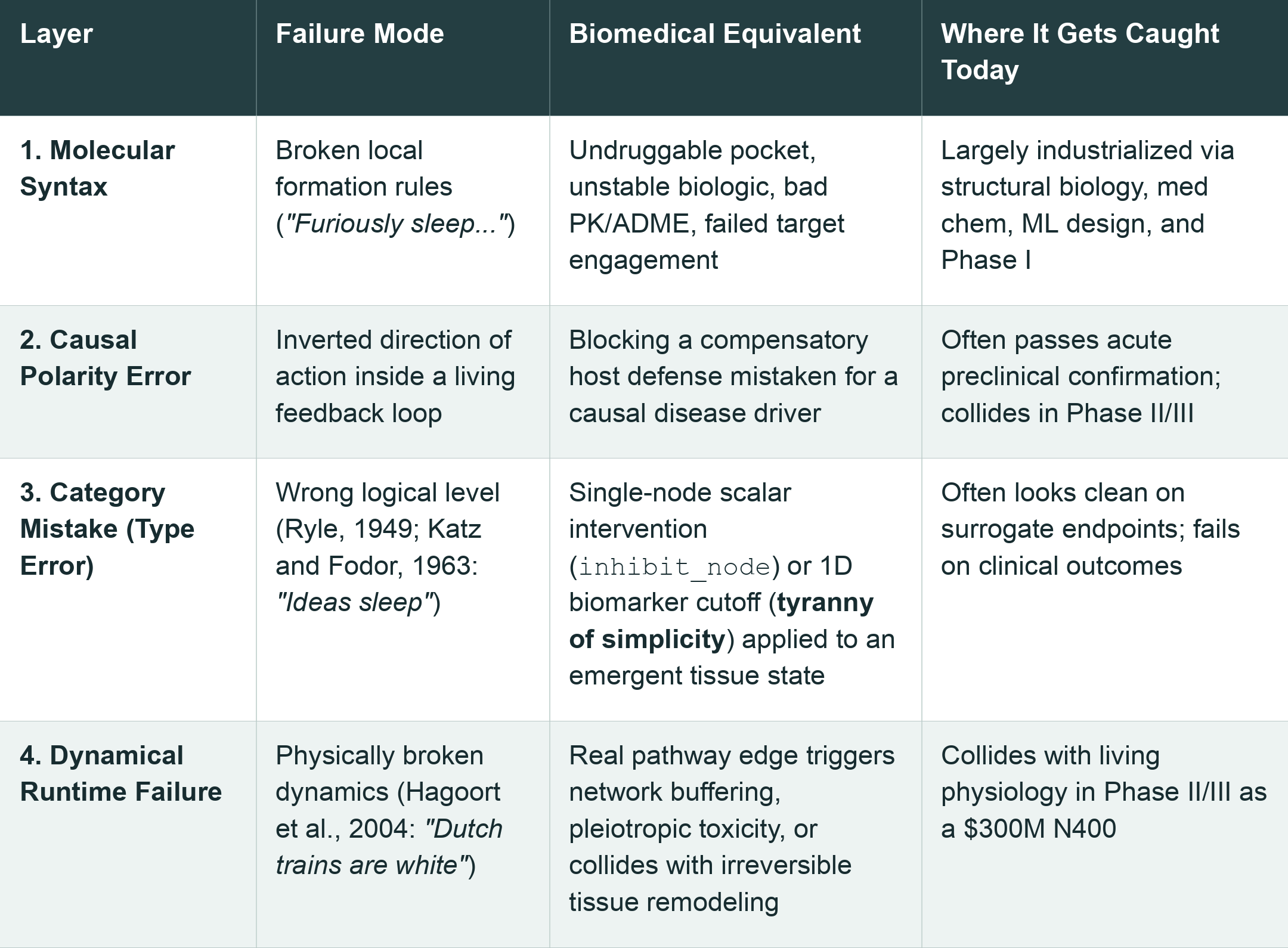
Table 1. Four failure layers separating industrialized molecular syntax (Layer 1) from causal, relational, and dynamical failures in living human physiology (Layers 2 to 4).
Layer 3 deserves special attention because clinical medicine enforces it structurally through what I call the tyranny of simplicity. Regulatory pathways, clinical guidelines, and billing codes all reward a single scalar biomarker with a single binary cutoff. One test with one threshold is straightforward to order, read, reimburse, and codify; validating a dynamic, multi-marker panel takes far more time and regulatory work. That institutional gravity flattens high-dimensional disease states into one-dimensional switches, reproducing Ryle’s Oxford University error at the bedside. In Section 3 we will look at major clinical trials where chasing a tidy one-dimensional surrogate actively harmed patients, and in Section 5 we will see why control theory predicts that failure.
Layer 1, by contrast, is where biomedical engineering has genuinely delivered. Cryo-EM, structure-guided medicinal chemistry, computational protein design, and Phase I pharmacokinetics have largely industrialized molecular syntax. Hand a strong team a well-defined protein target, and they can usually craft a selective, stable drug that engages it reliably in humans. Passing Layer 1 proves your molecular sentence parses. It says almost nothing about Layers 2, 3, or 4. To see what happens when well-parsed target hypotheses collide with living physiology, we need to look at the clinical attrition numbers and open a few Phase II and Phase III trial autopsies.
3. Phase II is a $300 million N400
When your brain reads “The Dutch trains are white,” it flags the clash with physical reality in roughly 400 milliseconds. Pharmaceutical R&D runs the same check on a much slower, far more expensive clock. A discovery team spends six to ten years engineering a molecule so that it passes every syntactic rule of Layer 1 (potency, selectivity, pharmacokinetics, manufacturability, and basic safety in Phase I), and only then asks human physiology whether the underlying target sentence is actually true. In medicine, that reality check is Phase II.
Look at the long-term record first. In 2012, Jack Scannell and colleagues documented Eroom’s Law (Moore’s spelled backward): from 1950 to 2010, FDA-approved drugs per inflation-adjusted billion R&D dollars fell roughly 80-fold, halving about every nine years. To keep the record fair, a 2020 follow-up co-authored by Scannell himself (Ringel et al., 2020) showed that productivity flattened and ticked upward during the 2010s. That recovery was real, driven largely by genetically guided rare diseases, targeted biologics, and biomarker-selected oncology, while complex chronic diseases stayed stubbornly resistant.
Across the broader industry, Phase II remains the bottleneck. In a 2021 analysis by BIO, Informa, and QLS Advisors tracking 9,704 clinical programs from 2011 to 2020, only 28.9% of drugs entering Phase II advanced to Phase III, and the overall probability of moving from Phase I to approval was just 7.9% (5.7% for small-molecule new molecular entities, 9.1% for biologics). Look inside that average and the biological divide is clear: Phase II transition rates reached 48.1% in hematology and 45.0% in metabolic disorders, then dropped to 24.6% in oncology and 21.0% in cardiovascular disease. Roughly seven out of ten Phase II bets stop right there. And when they fail, chemistry is rarely the reason. In Richard Harrison’s (2016) audit of 174 Phase II and III failures with stated causes, 52% failed simply for lack of clinical efficacy, with another 24% failing on safety or therapeutic index. The drug engaged its target as designed and still left the patient’s disease unmoved.
One accounting caveat on calling Phase II a “$300 million N400.” In a survey of 106 drugs across ten large pharma companies (in 2013 dollars), DiMasi, Grabowski, and Hansen (2016) put the mean direct out-of-pocket cost of a standalone Phase II trial at $58.6 million (with total spending per approved drug reaching $1,395 million out-of-pocket and $2,558 million capitalized). Nobody teleports a molecule straight into Phase II, though. Once you add target discovery, preclinical toxicology, GMP manufacturing, Phase I, and the Phase II readout itself, especially on a capitalized or attrition-adjusted basis (Paul et al., 2010), the cumulative bill burned to reach human proof of concept sits solidly in the $100 million to $300 million+ range. That is what it currently costs medicine to learn that a grammatically valid target sentence is biologically false.
Why throughput cannot rescue weak validity
When seven out of ten clinical bets fail, the engineering reflex is almost automatic: widen the funnel. Screen bigger chemical libraries faster and let scale beat the odds. Much of industrial high-throughput screening in the 1990s and 2000s was built on that bet, and it never moved the Phase II wall.
In 2016, Jack Scannell and Jim Bosley showed why using decision theory. Every candidate entering a discovery funnel carries a latent true clinical utility in humans and receives a score from a preclinical disease model. Call the correlation between the preclinical score and true human clinical utility the model’s predictive validity, ρ. When truly disease-modifying candidates are rare, say a base rate of p0 = 10−3 (one true clinical modifier per thousand candidates), scaling library size runs straight into the winner’s curse. Because 999 out of every 1,000 candidates are false positives, testing a hundred times more compounds mostly gives those false positives a hundred times more chances to generate a freak upward noise spike in your assay. Shifting ρ by just 0.1 (a gap too small for most wet labs to measure reliably) can offset a 10-fold to 100-fold swing in screening throughput.
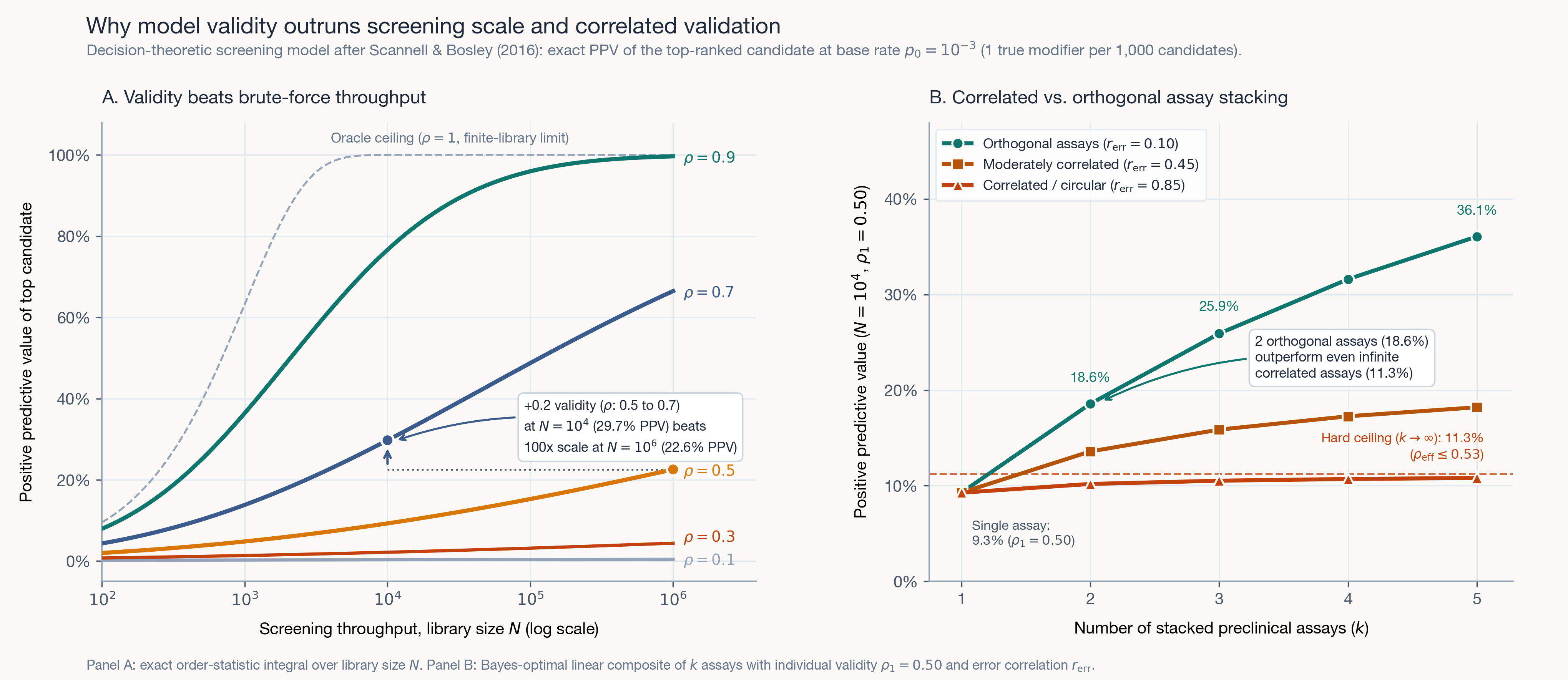
Simulation 1. Exact order-statistic positive predictive value (PPV) of the top-ranked candidate in a Scannell and Bosley (2016) screening model at base rate p0 = 10−3 (verified by Monte Carlo). Panel A compares library size N against predictive validity ρ. Panel B stacks k assays (individual validity ρ1 = 0.50, N = 104) across low, moderate, and high error correlation rerr.
Take a moment with Panel A, because it captures thirty years of biopharma frustration in a single chart. Advancing the top-scoring hit from a modest 10,000-compound screen (N = 104) run in a model with validity ρ = 0.7 delivers a 29.7% PPV. Now drop model validity by 0.2 (to ρ = 0.5) and build a screening factory a hundred times larger, testing one million candidates (N = 106): PPV still falls to 22.6%. At weak validity (ρ = 0.3), screening a million candidates leaves you at 4.4% PPV. Accelerating a weak filter mostly harvests stronger artifacts of the filter.
Before writing off cheap cell lines and biochemical assays altogether, though, any experienced discovery team has a fair, sensible pushback here. Ask a lead biologist for the clinical positive predictive value of a fast in vitro assay, and they will rightly tell you that nobody expects an immortalized cell line to predict human Phase II efficacy on its own. Cheap assays exist as gating functions, filtering out obvious non-starters (inactive molecules, poor cell permeability, unstable chemistry) before a program spends real time and money on slow, expensive primary human tissues or in vivo models.
That funnel logic is completely sound when the early gate preserves high negative predictive value (NPV). Imagine screening 1,000 candidates containing a handful of genuine human actives: if a cheap upstream assay discards 900 clear duds while letting almost every true active pass through to a slower, higher-validity model, low standalone PPV does not hurt you at all. Gating breaks down in two quieter ways. First, if the cheap cell line sits in the wrong cellular context (missing the relevant splice form, cofactor, microenvironment, or tissue feedback), it can silently throw away genuine human actives before they ever reach a richer test. Second, teams routinely slip from cheap gating into circular proof, pushing compounds through three, four, or five downstream assays in series and treating every cleared gate as independent confirmation of human efficacy.
Panel B exposes the exact math of that second habit. Stacking assays works only if those assays fail for independent reasons. Starting from individual assays of moderate validity (ρ1 = 0.50, 9.3% PPV alone), just two nearly orthogonal assays (rerr = 0.10) lift PPV to 18.6%, and five reach 36.1%. When stacked assays share 85% of their error variance (rerr = 0.85), as happens when an immortalized cell line, a pathway reporter, and an engineered mouse all test the same linear assumption, even an infinite chain plateaus forever at 11.3% PPV. Two independent checks beat an endless loop of circular confirmation. (This toy calculation assumes joint Gaussianity, top-1 selection, and an optimal linear average in Panel B; real pipelines using sequential hard cutoffs hit an equal or stricter ceiling under correlated errors.)
Two regimes of medicine and the tyranny of simplicity
Any medicinal chemist or protein engineer has a fair pushback here: Look at the biggest breakthroughs of the last decade. Wasn’t chemistry or modality delivery the real bottleneck?
In one part of medicine, yes. Lumping all of pharma into one diagnosis misses a sharp split between two regimes.
Regime 1 is the validated core: Mendelian disorders, monogenic proteinopathies, and clean somatic drivers where biology already handed us an unambiguous causal arrow. Here engineering drove genuine breakthroughs. Human genetics pointed straight to PCSK9, and monoclonal antibodies solved a flat protein interface to cut LDL cholesterol by 59% and reduce major adverse cardiovascular events by 20% in FOURIER (Sabatine et al., 2017). Once misfolded TTR tetramers were nailed down in amyloidosis, four completely different engineering modalities all succeeded in patients: kinetic stabilizers, RNAi, antisense oligonucleotides, and first-in-human in vivo CRISPR gene editing. In oncology, KRAS G12C resisted drugs for forty years until Ostrem et al. (2013) uncovered an induced switch-II pocket enabling covalent inhibitors like sotorasib (though even on a clear Regime 1 target, biology still pushes back through adaptive pathway reactivation). Structure-guided selectivity spared platelets to deliver venetoclax for BCL-2, and allosteric targeting delivered deucravacitinib for TYK2. Those victories explain much of Ringel et al.’s post-2010 uptick, and they also fish out a finite, crowded pond.
Regime 2 is the complex chronic frontier: polygenic, age-related, fibrotic, cardiovascular, immune, and neurodegenerative diseases. Clinicians rightly point out that Regime 2 trials fail for operational reasons too (patient stratification, tissue exposure, dosing cadence, noisy endpoints), though every one of those operational hurdles is a world-model problem one layer down.
Making Regime 2 harder still is the tyranny of simplicity in medicine. Remember Gilbert Ryle’s visitor at Oxford from Section 2, touring every college and lab and then asking where the University itself was hiding. Healthcare runs an institutional version of that same category mistake every day. Clinical workflows, regulators, and payers push steadily to flatten high-dimensional, evolving physiological states into a single scalar test with a single numerical cutoff. One cutoff is easy to order, easy to interpret in a brief office visit, easy to bill for, and easy to write into a clinical guideline. Validating a multi-marker dynamical panel is far slower and more expensive. When medicine starts treating those one-dimensional summaries as causal levers, patients pay the price.
Consider the Cardiac Arrhythmia Suppression Trial, or CAST (Echt et al., 1991). In the late 1980s, cardiologists knew that heart-attack survivors with frequent premature ventricular complexes (PVCs) suffered much higher rates of sudden cardiac death, and two drugs (encainide and flecainide) wiped out PVCs reliably. The hypothesis felt so obvious that many doctors questioned randomizing patients to placebo. Investigators enrolled post-heart-attack patients who had already passed open-label titration proving the drugs suppressed their PVCs. The scalar biomarker behaved flawlessly. Then the safety board looked at the patients: arrhythmic death and cardiac arrest more than doubled, and total mortality rose sharply alongside it. Suppressing an electrical correlate of scarred myocardium destabilized the very heart muscle doctors were trying to protect.
Seventeen years later, ACCORD delivered the same lesson in metabolism (Gerstein et al., 2008). Because high HbA1c correlates with diabetic complications, driving blood glucose below 6.0% looked monotonically better than standard targets (7.0% to 7.9%). Across thousands of high-risk Type 2 diabetes patients, pushing that single glycemic cutoff down increased all-cause mortality by roughly a fifth, forcing the trial to stop early after three and a half years. A single blood-test number inside a multi-organ metabolic system is rarely a safe monotonic dial.
Three clinical trial autopsies
Those proxy collapses connect straight to Layers 2, 3, and 4 from Section 2. Walking through three clinical stories shows how tidy local target grammar breaks the moment it meets living human physiology.
Layer 2 (Causal polarity error): Anti-TNF in septic shock. On an early-1990s cytokine slide, sepsis looked like a clear arrow: bacteria trigger TNF-α, and TNF-α causes shock and organ failure. In laboratory animals injected with an acute bolus of endotoxin right alongside anti-TNF, blocking TNF saved lives. In 1996, Charles Fisher and colleagues tested recombinant human dimeric p75 TNFR:Fc (the exact construct later approved as etanercept for rheumatoid arthritis) in ICU septic shock patients. Twenty-eight-day mortality rose monotonically with dose, climbing from 30% on placebo and low dose up to 48% at the middle dose and 53% at the highest dose. Two caveats keep the record fair: soluble p75 TNFR:Fc can act as a circulating carrier prolonging bound TNF signaling, and a meta-analysis of fifteen later anti-TNF sepsis trials (Qiu et al., 2013) found a small pooled survival tilt in the opposite direction. Even so, zero anti-TNF drugs ever won FDA approval in sepsis. Human ICU patients arrive hours or days into polymicrobial infection at completely different points between hyperinflammation and immunoparalysis, where TNF-α simultaneously mediates shock and defends against bacteria. Treating an essential host defense as if it were a pure disease driver turns a grammatical target sentence into a causal polarity error.
Layer 3 (Category mistake): The eighteen-year CETP detective story. No drug class isolates a biological category mistake more clearly than cholesteryl ester transfer protein (CETP) inhibition, because pharma ran the experiment five times across five molecules and tens of thousands of patients, stripping off chemical excuses one by one. Observational epidemiology linked higher HDL cholesterol (”good cholesterol”) to fewer heart attacks, and inhibiting CETP sent blood HDL-C soaring.
Pfizer’s ILLUMINATE trial of torcetrapib (Barter et al., 2007) raised HDL-C by more than 70% and cut LDL-C by roughly a quarter, then stopped early because cardiovascular events and all-cause mortality climbed substantially. Cardiologists had a reasonable explanation: torcetrapib carried off-target adrenal aldosterone toxicity that lifted systolic blood pressure by over 5 mmHg. So the field built cleaner molecules. Roche’s dal-OUTCOMES trial of dalcetrapib (Schwartz et al., 2012) removed that blood-pressure liability, raised HDL-C by 31% to 40%, and returned a flat null. Lilly’s ACCELERATE trial of evacetrapib (Lincoff et al., 2017) more than doubled HDL-C (up over 130%) and cut LDL-C by roughly 30% with clean safety, and still halted for futility after just over two years (though that shorter follow-up may have clipped late LDL gains).
Then Merck ran REVEAL (Bowman et al., 2017), following patients on anacetrapib for over four years. Anacetrapib edged past statistical significance on major coronary events with a modest 1 percentage-point absolute risk reduction, yet Merck declined to file: that entire benefit was explained by the 18% drop in non-HDL cholesterol on the standard Cholesterol Treatment Trialists line, leaving the more than doubling of HDL-C contributing essentially nothing alongside multi-year drug accumulation in adipose tissue. Finally, in 2025, BROADWAY (Nicholls et al., 2025) showed obicetrapib cutting LDL-C by roughly 30% with placebo-like safety, with its large PREVAIL outcomes trial now underway. Obicetrapib’s comeback clinches the point: CETP only worked once pharma abandoned the Rylean category mistake of confusing static HDL-C mass (a standing reservoir of cholesterol parked in particles) with reverse cholesterol transport flux (a dynamic clearance rate) and repositioned around causal ApoB and LDL-C clearance.
Layer 4 (Dynamical runtime failure): γ-secretase and broad-spectrum MMPs. Sometimes the enzyme truly sits on the pathway and the chemistry hits it on target, while the organism’s wider wiring fails underneath. In Lilly’s Phase III IDENTITY trial of semagacestat (Doody et al., 2013), inhibiting γ-secretase lowered amyloid production while Alzheimer’s patients performed worse on cognition, declined faster in daily functioning at the higher dose, and developed roughly six times as many skin cancers as patients on placebo. Inside an adult human, γ-secretase is a promiscuous protease cleaving Notch and dozens of essential substrates, and inhibiting it also piles up synaptic β-CTFs. Oncology hit the same runtime wall with broad-spectrum matrix metalloproteinase (MMP) inhibitors (Coussens, Fingleton, and Matrisian, 2002): across advanced solid tumors, Phase III trials failed uniformly alongside dose-limiting musculoskeletal syndrome. Early-stage animal tumor assays missed that specific MMPs cleave collagens to release endogenous anti-angiogenic brakes (endostatin and arresten) and behave differently once metastatic disease is already established.
Human genetics helps, and then hits a ceiling
After those autopsies, the natural question is why we do not simply restrict our pipelines to targets backed by human genetics.
Human genetics is the strongest practical filter biopharma has added in twenty years. In 2024, Eric Minikel, Jeffery Painter, Coco Dong, and Matthew Nelson (Nature) audited nearly 30,000 monotherapy target-indication pairs against human gene-trait associations. Programs backed by human genetic support were roughly 2.6 times more likely to advance from Phase I to approval, rising to roughly 3.4 to 3.7 times more likely when backed by clean Mendelian evidence. Look at where that lift occurs: genetics barely moves Phase I-to-II (basic safety and PK), delivers its largest jump right at Phase II-to-III where target-disease causality is tested, and still helps from Phase III to launch. Yet do the basic arithmetic beside that multiplier: applying a 2.6-fold lift to a roughly 7% to 10% industry baseline puts the absolute approval probability of genetically supported clinical programs around 15% to 25%. Roughly three-quarters still fail.
One Alzheimer’s program makes that ceiling painfully concrete. A critic might say semagacestat failed only because γ-secretase cleaves Notch. Look instead at BACE1. In 2012, Icelandic geneticists discovered a rare protective coding variant in APP (A673T) sitting right at the BACE1 cleavage site that cuts amyloidogenic cleavage by roughly 40% and protects carriers against Alzheimer’s disease (Jonsson et al., 2012). You could scarcely ask for a clearer human genetic green light. Merck’s selective BACE1 inhibitor verubecestat crushed its biomarker, slashing cerebrospinal fluid Aβ40 by 71% to 81% and Aβ42 by 63% to 76% across its 12 mg and 40 mg daily doses in EPOCH (Egan et al., 2018). Verubecestat still failed in mild-to-moderate Alzheimer’s, and when pushed earlier into prodromal disease in APECS (Egan et al., 2019), it caused clear cognitive and functional worsening and faster progression to dementia.
If BACE1 sounds like a special quirk of neurodegeneration, look at what happened in cardiovascular medicine just weeks ago. On November 7, 2026, two separate Phase III cardiovascular outcomes trials were presented back-to-back in the exact same late-breaking session at the American Heart Association Scientific Sessions and published simultaneously in The New England Journal of Medicine. Both targets held everything modern drug discovery asks for: Mendelian human genetics, decades of real-world cohorts confirming strong risk stratification, and massive human target engagement.
In Lp(a)HORIZON (Cho et al., 2026), Novartis and Ionis tested the antisense oligonucleotide pelacarsen against lipoprotein(a), a lipid particle backed by textbook Mendelian randomization linking lifelong elevated LPA variants to coronary disease (Clarke et al., 2009; Kamstrup et al., 2009) and decades of prospective cohorts separating high-risk patients cleanly. Over nearly five years of follow-up in patients with established atherosclerotic cardiovascular disease on intensive background therapy, pelacarsen slashed circulating Lp(a) by roughly 78% at one year (nearly 74% time-averaged across the trial). Yet major cardiovascular events stayed completely flat overall and across higher-Lp(a) and inflammatory subgroups, alongside higher discontinuation rates and cases of anaphylaxis. Right beside it, Novo Nordisk’s ZEUS trial (Ridker et al., 2026) tested the anti-IL-6 monoclonal antibody ziltivekimab in high-risk patients with established atherosclerotic cardiovascular disease, chronic kidney disease, and systemic inflammation, backed by IL6R Mendelian genetics (IL6R Genetics Consortium, 2012) and decades of hs-CRP and IL-6 risk-stratification cohorts. Ziltivekimab lowered free IL-6 by 76% and hs-CRP by 64%, and because IL-6 signaling regulates the LPA gene promoter, it simultaneously lowered circulating Lp(a) by 29%. Knocking down systemic inflammation and Lp(a) together inside one trial still produced completely flat cardiovascular, mortality, and kidney outcomes, alongside higher serious infections. In the wake of those readouts, Novo Nordisk halted two Phase III heart-failure trials of ziltivekimab (HERMES and ATHENA), and Merck KGaA shelved its own Lp(a) candidate zerlasiran rather than commit to a Phase III outcomes study.
Read those twin failures carefully, without overclaiming. Neither trial proves that Lp(a) or IL-6 is non-causal in lifelong human biology: Mendelian genetics still shows that decades of elevated Lp(a) genuinely raise lifetime cardiovascular risk, and ongoing siRNA, oral, and primary-prevention trials (including OCEAN(a)-Outcomes with olpasiran and ACCLAIM-Lp(a) with lepodisiran, which achieve deeper knockdowns or treat earlier) have not yet read out. What Lp(a)HORIZON and ZEUS prove right now is the same hard boundary BACE1 ran into: you can hold all three of biopharma’s gold-standard cards (Mendelian human genetics, reliable real-world risk stratification, and ~75% to 80% human biomarker knockdown) and still come up empty when intervening late inside an already remodeled adult vascular system on modern background care.
Compare the lifelong genetic variant with the adult drug across both Alzheimer’s and cardiovascular disease. The Icelandic APP A673T mutation gently attenuates one single substrate (APP) by roughly 40% continuously from conception, and protective LPA or IL6R alleles quietly reduce vascular and inflammatory wear across seventy years of arterial development. By contrast, an adult pill or injection clamps a molecular variable hard to a low level (pinning a target variable down by roughly 75% to 80% with a drug rather than gently steering the broader dynamical system), whether across every adult synaptic substrate BACE1 touches (including SEZ6 and neuregulin-1) or abruptly inside a seventy-year-old arterial wall that has already spent decades remodeling around the disease. Human genetics proves a gene sits on the causal graph of lifetime disease risk, and epidemiology proves a biomarker can stratify who is in trouble. Neither hands you a dynamical model of adult therapeutic controllability: knowing when, how hard, and along which lever you can steer an evolved, remodeled living system back toward health. That is fundamentally a control problem, and we will unpack it through control theory in Section 5.
4. More data does not buy semantics
Whenever clinical attrition refuses to budge, biomedicine tends to buy a faster instrument and measure more parts. Three generations of biologists have warned that a bigger catalog does not assemble itself into understanding. Robert Rosen (1991), whose modeling relation we introduced in Section 2, argued that life resides in the relational closure of causes, while a bare parts inventory misses how those causes couple. In 2002, Yuri Lazebnik published “Can a Biologist Fix a Radio?” in Cancer Cell, imagining biologists trying to repair a broken transistor radio by ripping out components until the sound stops, crowning that resistor the “Most Important Component,” and chanting pharma’s mantra: “Give me a target!” Without a schematic language for how parts couple, adding more molecules to an apoptosis diagram made repair harder. Sydney Brenner (2010) termed the sequencing wave “low input, high throughput, no output” biology, adding a constructive point often edited out of the quote: complaining about data collection accomplishes nothing until we build a theoretical framework linking sequences to cellular computation.
Today, that scaling instinct has a new flagship: single-cell foundation models and what Charlotte Bunne and colleagues (2024, Cell) laid out as “AI Virtual Cells.” (If you sat through enough conference panels in San Francisco this year, “virtual cell” showed up on roughly every second slide deck, usually without a clear definition of what the cell was supposed to predict.) Their roadmap is ambitious: unify single-cell RNA-seq, spatial omics, imaging, and proteomics into shared representations that predict cellular perturbation responses in silico.
So how are those models actually performing?
The late-2026 verdict on virtual cells and the metric wars
In August 2025, Constantin Ahlmann-Eltze, Wolfgang Huber, and Simon Anders (Nature Methods) ran a clear empirical check. They benchmarked seven deep-learning models (five single-cell foundation models plus two dedicated perturbation architectures) against four deliberately simple baselines: predicting no change, predicting the mean training perturbation, summing single-gene effects for double knockouts, and fitting a basic PCA plus linear ridge regression. Across standard CRISPR Perturb-seq screens, none of the seven deep-learning models consistently beat simple linear or additive baselines on unseen single or double knockouts.
Stopping the story in mid-2025, though, would miss real progress over the past year. By November 2026, the empirical evidence has split cleanly along task lines, and that split tells you almost everything about what scale can and cannot buy.
What beats simple baselines now is cross-context transfer of targets already perturbed experimentally, trained on massive interventional atlases. Vevo/Tahoe Therapeutics released Tahoe-100M (Zhang et al., 2025), roughly 100 million chemically perturbed single cells across dozens of cell lines. In September 2026, the Arc Institute published State (Cell; Adduri, Roohani et al., 2026), combining an observational encoder pretrained on ~167 million cells with a set-transformer transition module trained on more than 100 million perturbed cells, reporting 30% to 50%+ gains in perturbation discrimination and better differentially expressed gene recovery when transferring a seen perturbation into a held-out cell line. Illumina’s CellularAI won the 2026 Virtual Cell Challenge on the same principle, backed by its proprietary Billion Cell Atlas across more than 200 cell lines. Notice why those models succeed, and why cross-context transfer stays fundamentally different from causal inference. Because the model already observed that drug or knockout signature across many reference lines during training, transferring it into a held-out cell line does not require discovering underlying causal mechanisms from scratch. Largely, the model is learning the gene-gene covariance matrix (which co-regulated transcriptional modules rise and fall together inside mammalian cells) alongside context-specific baseline shifts, then projecting a previously measured perturbation shift into the new cell line’s background. That interventional interpolation across contexts is genuinely useful engineering when you already hold perturbation measurements in neighboring lines. It still breaks down when you ask for a truly unseen gene knockout whose signature never appeared in training, or move into a primary diseased tissue whose causal wiring has rewired away from the training covariance structure.
What stays stubbornly broken is true zero-shot prediction of unseen gene knockouts once generic stress is removed. In Systema (Viñas Torné, Brbić et al., Nature Biotechnology, 2025/2026), researchers showed that perturbed cells share a large systematic stress and selection shift (δ̄sys) relative to unperturbed controls. Once you subtract that shared shift and compare against a nonctl-mean baseline across ten datasets, deep models barely exceed baseline distributions on unseen single knockouts, with only coarse pathway grouping reaching a ROC-AUC around 0.7. Non-additive combinatorial epistasis still regresses toward additivity. And even a perfect predictor of 72-hour mRNA counts in an immortalized cancer cell line models an isolated transcriptional shadow stripped of vasculature, immune memory, and seventy years of aging.
Why did three top journals publish seemingly contradictory headlines on overlapping CRISPR datasets between August 2025 and October 2026? Look at the geometry of the perturbation metric wars. In a 20,000-gene matrix, a typical knockout meaningfully moves 20 to 200 genes while more than 98% of the matrix sits in measurement noise plus the shared stress shift δ̄sys. Score models by unweighted Euclidean error or Mean Absolute Error (MAE), and bold specific predictions get penalized whenever amplitude is slightly off, so shrinking to the mean wins by default (breaking MAE in the 2025 Virtual Cell Challenge, where nearly every deep model scored worse than a mean baseline). Score models by unweighted correlation against unperturbed controls, and predicting generic stress δ̄sys buys a high score for free (Systema). Switch to an ℓ1-based Perturbation Discrimination Score (PDS) to reward unique signatures, and Team Outlier (Liu et al., November 2025, arXiv:2511.16954) proved you can artificially inflate ℓ1-PDS just by multiplying predictions by a global scalar without improving the biology, forcing a 2026 rewrite to cosine-PDS. Finally, Miller, Mejia et al. (Nature Biotechnology, October 2026) showed that calibrating metrics against biological replicates and weighting toward differentially expressed genes recovers real signal above uninformative baselines. The lesson is straightforward: trying to grade semantic truth in raw 20,000-gene observation space invites Goodharting until scores anchor to downstream causal control.
Science slop at scale
While transcriptomic models wrestle with observation space, large language models have created a parallel failure mode on the hypothesis side: computational meaning coercion. Remember Mante Nieuwland and Jos van Berkum’s (2006) “peanuts in love” experiment from Section 1, where a brief cartoon story silenced the human brain’s N400 detector for “The peanut was in love” and made it fire on the literally true “The peanut was salted.”
Frontier LLMs and AI scientist workflows have pushed biomedical R&D from idea scarcity into idea abundance. Hand an agent or knowledge graph a differentially expressed gene and a chronic indication, and thirty seconds later it produces a polished, citation-dense target dossier with pathway mechanisms and biomarker plans. Every sentence obeys biomedical grammar, switching off the internal N400 of any reader outside that narrow sub-pathway. It is Murray Gell-Mann amnesia scaled across a portfolio: you spot the subtle leaps between mouse biology and human disease in the two pathways you spent a decade studying, turn the page, and accept the equally fluent rationale in the next indication. (I wrote separately about running into this in production AI scientists in Science slop at scale.) Without skeptical domain experts and causal falsification in the loop, automating hypothesis generation mostly industrializes “colorless green” targets.
What the Bitter Lesson actually compresses
Before pushing further, we need to steelman the strongest counterargument from machine learning: Rich Sutton’s (2019) Bitter Lesson. Across seventy years of chess, Go, speech, and vision, general compute via search and learning has repeatedly beaten hand-crafted domain rules. Anyone claiming biology sits outside that rule needs a precise boundary condition.
Two examples earn full credit. First, Othello-GPT: Li et al. (2023) trained an autoregressive transformer exclusively on raw transcripts of legal Othello moves with zero explicit rules and probed out a causally editable internal 8x8 board state. Nanda, Lee, and Wattenberg (2023) strengthened that finding by showing that in the player-relative basis (my color vs. opponent’s color), the emergent world representation is linear. Second, AlphaFold2 (Jumper et al., 2021) hit a median CASP14 GDT_TS of 92.4 and 0.96 Å backbone accuracy without running molecular dynamics folding simulations. Its neural Structure Module predicts 3D coordinates by iteratively updating rigid-body residue frames, followed only by a short restrained Amber99sb gradient-descent energy minimization (L-BFGS in OpenMM) to clean up local stereochemical clashes, a post-processing cleanup that Jumper and colleagues explicitly note does not improve global structural accuracy. AlphaFold2 still relies on evolutionary Multiple Sequence Alignments (MSAs) to navigate into the right folding basin, and accuracy falls sharply below roughly 30 MSA sequences (even single-sequence protein language models amortize that same evolutionary sequence archive inside their weights and degrade similarly on true orphan proteins).
Why did scale build exact board physics in Othello and near-atomic folds in AlphaFold2, while stalling on static human disease atlases? Look at what is actually being compressed inside each training stream.
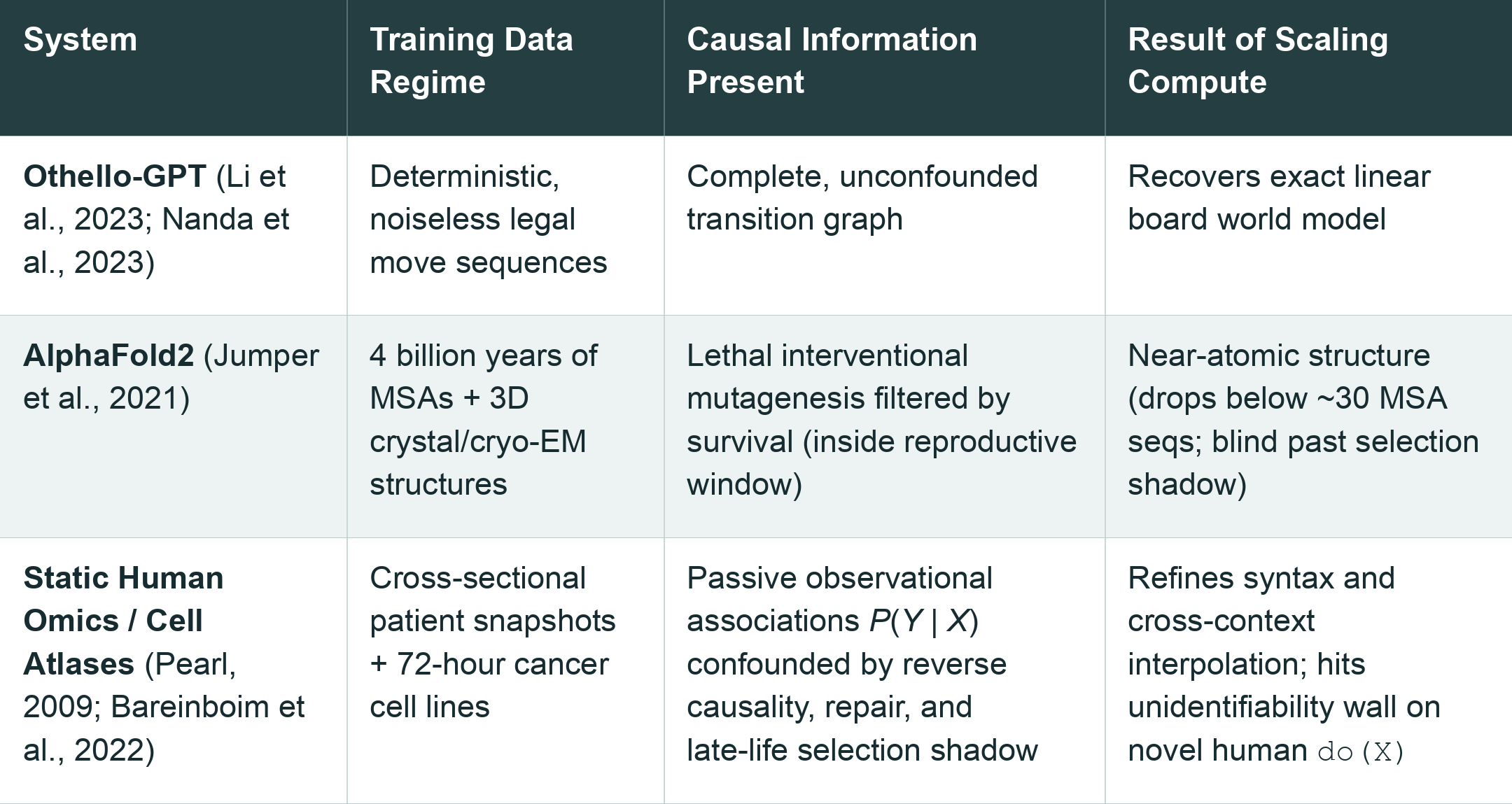
Table 2. What scaling compute compresses across three algorithmic and biological regimes.
Othello gives a learner a noiseless, fully observed transition graph. AlphaFold2 did not deduce 3D biophysics from passive text; evolutionary MSAs are compressed readouts of four billion years of lethal interventional mutagenesis filtered by survival and anchored to physical 3D structures. When mutating residue A breaks an essential fold unless residue B mutates to compensate, organisms carrying the broken fold die and drop out of the sequence database. Natural selection ran the interventional experiment for us.
Evolution stops running that experiment right where Regime 2 chronic medicine starts. Peter Medawar (1952) called this the selection shadow: because extrinsic hazards like infection and predation drive remaining reproductive value toward zero with age, late-onset deleterious alleles escape purifying selection. George C. Williams (1957) added antagonistic pleiotropy: natural selection actively favors circuits that boost early-life survival and reproduction (rapid clotting, aggressive wound scarring, pathogen defense, tumor-suppressing cellular senescence) even when those exact circuits damage organs at age 70. Modern human genomics confirms that trade-off: analyzing more than 276,000 UK Biobank participants, Erping Long and Jianzhi Zhang (2023) documented a clear negative genetic correlation between reproductively advantageous alleles and old-age survival (seen clinically in APOE ε4 and chronic fibrotic senescence). Natural selection ran trillions of experiments on keeping a kinase folded at 37 °C, and almost zero on safely reversing forty years of calcified plaque, lung fibrosis, or neurodegeneration.
To see why throwing bigger observational datasets at late-life disease cannot fill that evolutionary gap, it helps to use Judea Pearl’s (2009) Ladder of Causation, which organizes causal inference into three distinct rungs:
Rung 1 is Association (Seeing), written P(Y ∣ X): passive observation asking “if I observe elevated protein X in a patient’s blood, how likely is disease Y?” Standard epidemiology, differential expression, and correlative machine learning all live here.
Rung 2 is Intervention (Doing), written P(Y ∣ do(X)): active manipulation asking “if I dose a drug that pushes X down inside this patient, what actually happens to disease Y?” Clinical medicine lives here.
Rung 3 is Counterfactuals (Imagining): retrospective reasoning asking “given that this specific patient worsened after treatment, would they have recovered had we intervened differently or earlier?”
Without evolutionary mutagenesis supervising late-life disease reversal, static cross-sectional human omics sit squarely on Rung 1. Bareinboim, Correa, Ibeling, and Icard (2022) proved the Causal Hierarchy Theorem: for almost all structural causal models (outside a set of measure zero), even infinite Rung 1 observational data cannot uniquely identify Rung 2 interventional outcomes, P(Y ∣ do(X)), without extra causal structure. Like anti-TNF in sepsis, a causal driver (B → D) and a compensatory host defense (D → B ⊣ D) can produce nearly identical cross-sectional cohorts across tens of thousands of patients, while blocking B cures one and worsens the other.
Two earlier essays of mine, included in full as Appendix A and Appendix B at the end of this piece, unpack this identifiability wall in detail. Appendix A (We may never understand biology, and machine learning may not either, but maybe it won’t matter) walks through why even a tiny six-gene oscillatory network defeats correlation-based reverse engineering, and why biological degeneracy keeps passive inference from converging on a unique mechanism. Appendix B (Right for the Wrong Reasons) builds a worked hidden-state signaling ODE showing how a neural network can look accurate on observed trajectories while missing the hidden feedback loop underneath, hit a flat structural error plateau as passive data grows, and break under a novel drug perturbation. We will visualize that cross-sectional causal barrier in Section 5 (Simulation 3).
Phenotypic screening as an analog world model
If static omics and isolated target slides cannot reliably predict human interventions, how did pharmacology discover effective chronic medicines before genomics? Because intact living cells, tissues, and whole organisms are physical analog world models. They execute nonlinear feedback, signaling cross-talk, pharmacokinetics, and homeostatic buffering in real time, whether or not any human can write down the equations. Aspirin, lithium, metformin, cyclosporine, statins, and GLP-1 agonists (from Gila monster venom physiology) all emerged from empirical phenotypes in living biological systems.
Keep the phenotypic versus target-based debate balanced, because one well-known audit often gets cited without its rebuttal. In 2011, David Swinney and Jason Anthony (Nature Reviews Drug Discovery) audited 259 FDA approvals (1999 to 2008) and found that among 50 first-in-class small molecules, 28 (56%) came from phenotypic screening versus 17 (34%) from target-based discovery (plus 5 natural-substance modifications), while target-based methods dominated followers (83 vs. 30). Three years later, Jörg Eder, Richard Sedrani, and Christian Wiesmann (2014) expanded the window to 1999 to 2013 across all 113 first-in-class drugs including biologics and separated blind library screens from “chemocentric” starts built on known empirical pharmacology: 78 (69%) were target-based (45 small molecules and 33 biologics), 25 (22%) were chemocentric, and 8 (7%) were classical blind phenotypic screens (plus 2 other). Together, the two audits fit our two regimes neatly: target-based discovery excels in Regime 1 once a clear causal arrow exists, while intact living systems act as analog world models when our target hypothesis is incomplete or wrong.
Building a model is like building a time-travel machine
If living biology is already an analog world model, why not just screen inside mice, organoids, and primary tissues and stop worrying about computational world models? Because physical analog models run straight into three physical walls, starting with time.
Suppose I offer you the perfect translational Alzheimer’s model with 100% positive predictive value for human clinical efficacy, and the only catch is that it takes 50 years to read out an answer. Its practical utility is basically zero. (I have never met a portfolio committee or a venture board willing to wait half a century for a preclinical milestone.) To compress decades into weeks inside human careers and funding cycles, preclinical biology builds time-travel machines: we flood assays with supraphysiological ligands, stack aggressive mutations, or massively overexpress receptors.

A translational model with 100% predictive accuracy that takes fifty years to read out has near-zero utility. Speeding up biological time means pushing homeostatic buffers hard enough to break them, and overwhelming too many buffers at once breaks relevance along with them.
Living dynamics fight back against that shortcut. Healthy organs stay stable across decades through layered homeostatic buffers (proteostasis, inflammatory resolution, metabolic stress shields). Much of chronic human disease happens when decades of slow wear erode one buffering system until the tissue loses control and drops into a new, metastable pathological state.
Look at what breaks when labs force 50 years into 60 days. The workhorse 5xFAD Alzheimer’s mouse (Oakley et al., 2006) stacks five familial mutations under heavy overexpression so intraneuronal Aβ42 appears by 1.5 months and plaques by 2 months. Takaomi Saido’s knock-in audits (Sasaguri et al., 2017) showed that APP overexpression floods neurons with artificial cleavage fragments (β-CTFs, sAPP) and aberrant calpain p35-to-p25 hyperactivation unrelated to sporadic human aging. Auditing 40 widely used transgenic mouse lines, Leslie Goodwin and colleagues (2019) discovered that random transgene insertion disrupted endogenous coding genes in 50% of all lines. Neurodegeneration paid the translational invoice: Cummings, Morstorf, and Zhong (2014) tallied a 99.6% failure rate in Alzheimer’s trials from 2002 to 2012 (predating the modest cognitive slowing of anti-amyloid antibodies lecanemab and donanemab in 2023 and 2024, which still leaves the first-generation overexpression record bleak).
Fibrosis shows the exact same dynamic trap from a different angle. Miri Adler, Uri Alon, Ruslan Medzhitov, and colleagues (2020) modeled the core macrophage-myofibroblast tissue-repair circuit and showed that one single biological circuit, operating under identical underlying parameters, holds three stable steady states separated by a sharp threshold called a separatrix: normal healing, “hot fibrosis,” and “cold fibrosis.” In hot fibrosis, infiltrating macrophages and activated myofibroblasts lock into a reciprocal growth-factor loop (macrophages secrete signals driving myofibroblast survival and proliferation, while myofibroblasts secrete signals recruiting and sustaining macrophages), driving active inflammatory scarring. In cold fibrosis, myofibroblasts cross a density threshold where their own autocrine growth-factor loops sustain them indefinitely even after macrophages depart the tissue, creating an autonomous, immune-independent scar. Clinically, that difference is everything. An anti-inflammatory drug that strips away macrophage signaling can collapse hot fibrosis and pull tissue back toward normal healing if you intervene on the right side of the separatrix; once an organ tips into cold fibrosis, wiping out immune signals does nothing because the myofibroblast circuit no longer needs macrophages to survive. Acute-shock animal models typically test drugs before the separatrix or inside hot inflammatory scarring, while chronic human patients walk into a Phase II clinic years later already parked inside cold fibrosis.
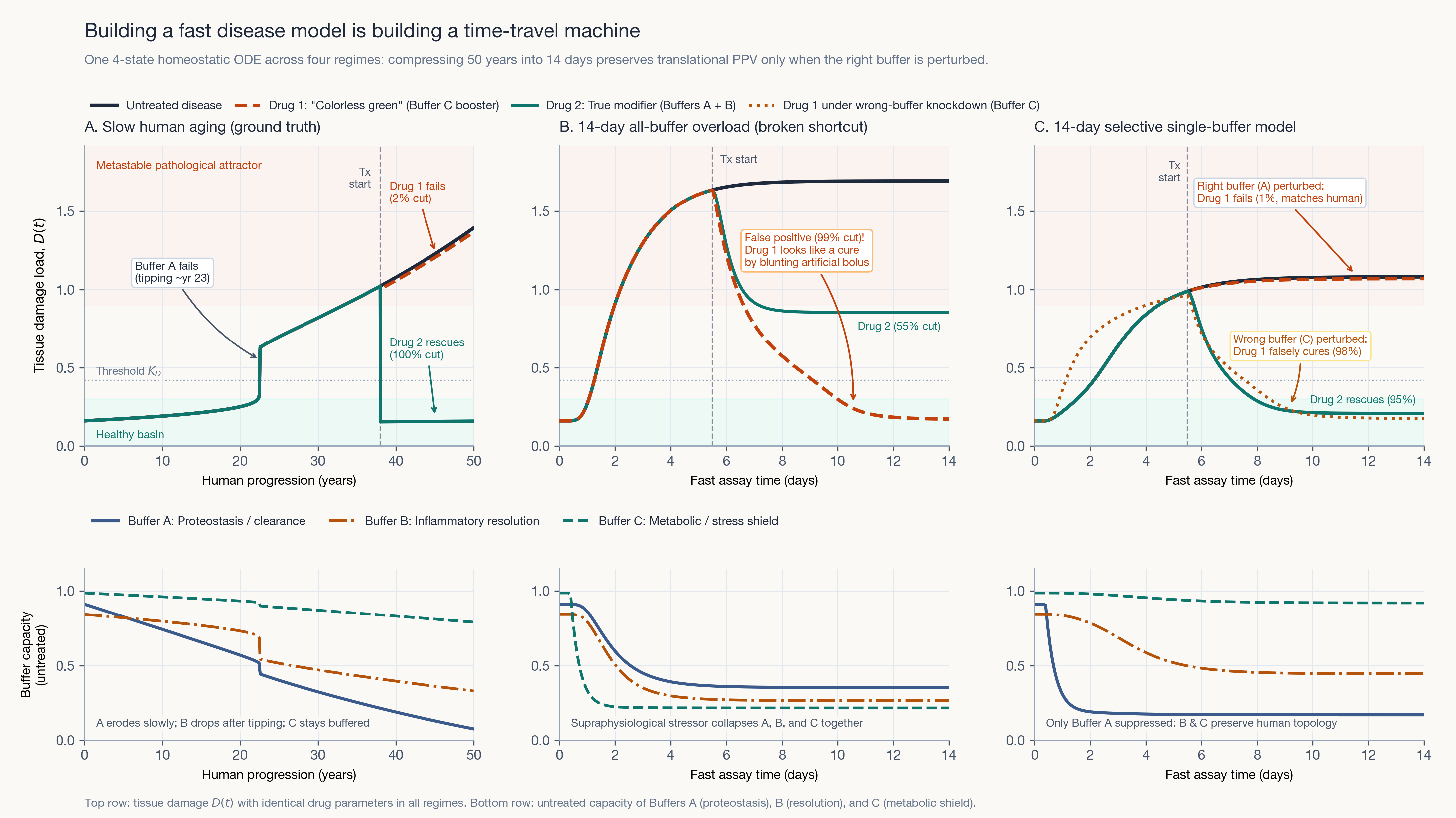
Simulation 2. One 4-state homeostatic ODE across four regimes with identical parameters and pharmacological doses modeling tissue damage D(t) protected by proteostasis (Buffer A), inflammatory resolution (Buffer B), and a metabolic stress shield (Buffer C). Panel A: 50-year human aging via slow Buffer A erosion. Panel B: 14-day supraphysiological overload collapsing all three buffers. Panel C: 14-day selective single-buffer knockdown comparing the right buffer (A) against the wrong buffer (C).
Follow the two candidate drugs across Simulation 2. In Panel A (50-year aging via gradual erosion of Buffer A until tipping around year 23), Drug 1 (a “colorless green” Buffer C booster) cuts damage by just 2.2% (failure), while Drug 2 (restoring Buffers A and B) cuts damage by 100%. Compress 50 years into a 14-day all-buffer overload (Panel B) that slams an acute shock hard enough to collapse all three buffers together, and the ranking inverts completely: Drug 1 looks like a 99.3% cure by blunting the artificial exogenous shock, while Drug 2 drops to 54.8%. In Panel C, compressing time by weakening one single buffer exposes the real design dilemma: knocking down the right buffer (Buffer A) recovers the human ranking (1.3% for Drug 1 vs. 94.9% for Drug 2), while knocking down the wrong buffer (Buffer C) recreates the false-positive mirage (98.4% vs. 48.4%). Real organs add spatial remodeling, irreversible cell loss, and dozens of coupled loops, so the trap stays tight: overwhelming multiple buffering systems destroys biological relevance, and overwhelming a single buffering system preserves it only if you already know which single buffering system fails in humans.
Two other physical walls sit right behind time: cross-scale translation (an organoid or young mouse cannot capture vascularized organs, decades of immune memory, tissue pharmacokinetics, and real human comorbidities) and combinatorial search (wet labs cannot physically test every target combination, dose ratio, and timing schedule across heterogeneous patient endotypes).
5. Medicine is humans doing control theory
Look at where the first four sections leave us. Static omics atlases describe molecular syntax remarkably well, while passive observation hits a causal identifiability wall. Animal models act as analog simulators of living biology, while squeezing fifty years of human aging into a few weeks forces us to overload homeostatic buffers until we rewrite the disease itself. If neither passive data nor brute-force time compression yields a reliable map of chronic human disease, what kind of model are we trying to build?
It helps to state plainly what medicine actually does. Medicine is humans doing control theory. When an endocrinologist titrates insulin, a cardiologist adjusts blood pressure drugs, or an immunologist doses a biologic, they are steering a noisy, drifting, partially observed dynamical system out of a pathological state and holding it inside a safe operating range. Molecular biology trained us to search for static parts and draw linear pathway arrows. Once you treat therapy as steering a living system, a different set of mathematical rules takes over.
The cybernetic starting point is Roger Conant and W. Ross Ashby’s 1970 theorem: “Every good regulator of a system must be a model of that system.” Formally, any deterministic regulator that is maximally successful and maximally simple must form a mathematical mapping (a homomorphism) of the system it regulates. Put that beside Ashby’s earlier Law of Requisite Variety (1956), boiled down to “only variety can destroy variety.” If a chronic disease fails along ten independent physiological trajectories, a controller with one fixed knob cannot stabilize all ten. That explains why the tyranny of simplicity keeps breaking down in Section 3: trying to govern a multi-endotype chronic disease with one fixed dose and one binary biomarker threshold violates requisite variety from the start.
Look closely at the mathematics, though: Conant and Ashby’s theorem carries a famous loophole. Critics including John Wentworth, Victoria Krakovna, and a 2025 categorical analysis by Nathaniel Virgo, Martin Biehl, Manuel Baltieri, and Matteo Capucci pointed out that the original proof assumes direct, noiseless state observation and defines “model” so weakly that a hard-coded reflex or static lookup table qualifies. A wall thermostat regulates room temperature well without simulating thermodynamics. Oddly enough, that loophole describes Regime 1 medicine almost to the letter: when a single Mendelian mutation causes lifelong high LDL cholesterol, clamping PCSK9 works like a reliable reflex without simulating the rest of human cardiovascular physiology.
What closes the loophole and forces a real internal model is disturbance rejection under severe distributional shift. In linear control, Bruce Francis and W. Murray Wonham (1976) proved via the Internal Model Principle that rejecting persistent external disturbances robustly requires a dynamical copy of the disturbance-generating process inside the controller. For adaptive agents more broadly, Jonathan Richens and Tom Everitt (2024, ICLR) proved that achieving low regret across a sufficiently wide family of distributional shifts mathematically requires learning an approximate causal world model. Think about the shift a chronic-disease drug must survive: from an immortalized cell line or an eight-week inbred mouse to a comorbid 70-year-old human carrying decades of immune history and vascular scarring. Across a jump that wide, lookup tables inevitably break.
Biology is not a Boeing 747
Anyone who has worked at a wet-lab bench naturally pushes back here. Living organisms are not Boeing 747s. Nobody designed a human liver from modular blueprints with neat test ports. Organisms are evolved, degenerate, non-stationary systems spanning ten orders of magnitude in space and time, layering redundant backup paths over machinery that shifts continuously with age and environment.
I wrote earlier about why that evolutionary messiness means we may never compress a cell into Newton-style laws, and that full essay appears below as Appendix A (We may never understand biology, and machine learning may not either, but maybe it won’t matter). There, I walk through Gregory Chaitin’s algorithmic incompressibility, Stephen Wolfram’s computational irreducibility, chaotic gene-network dynamics, and a 6-gene repressilator whose oscillations fool standard statistical inference into drawing the wrong wiring diagram. Even before reading Appendix A, the practical worry is obvious: if we cannot read off a cell’s schematic, how could control theory work in medicine?
An even sharper objection comes from network control itself. In 2011, Yang-Yu Liu, Jean-Jacques Slotine, and Albert-László Barabási (Nature) applied linear structural controllability to real directed networks. In Table 1 of their paper, controlling yeast and E. coli gene transcriptional networks required directly driving 75.1% to 96.5% of all nodes (75.1% in TRN-EC-2, 82.1% in TRN-Yeast-2, 89.1% in TRN-EC-1, 96.5% in TRN-Yeast-1, often summarized as roughly 80%), while driver nodes avoided hubs. If steering a microbial gene network takes grabbing almost every gene at once, does control theory prove pharmacology is doomed?
Look closely at what Liu and colleagues were asking, and that paradox unravels in three clear steps.
First came a straightforward biological check. Within months, Franz-Josef Müller and Andreas Schuppert (2011, Nature) pointed to Kazutoshi Takahashi and Shinya Yamanaka (2006, Cell), who reprogrammed adult fibroblasts back to pluripotency using just four transcription factors, nowhere near 80% of the genome. In their reply, Liu and colleagues conceded the exact gap: full linear structural control asks what it takes to force a network to any arbitrary microscopic coordinate in a 20,000-gene space, including unnatural states no living cell could ever survive. Reprogramming and medicine only need to move a tissue from one naturally occurring attractor (a stable, self-sustaining biological state) into another.
Second, once you keep real nonlinear feedback (and restore local nodal decay, which simple bipartite graph matching ignores), the control burden shrinks sharply. Jorge Gómez Tejeda Zañudo, Gang Yang, and Réka Albert (2017, PNAS) proved that steering broad nonlinear biological networks into any natural attractor does not require touching every node or knowing every kinetic constant. Controlling source nodes plus a Feedback Vertex Set (nodes whose removal cuts every directed feedback loop) is mathematically sufficient, because feedback loops carve biology’s basins of attraction.
Third, in actual disease networks, you often need even fewer levers because a temporary nudge across a basin boundary is enough. Sean Cornelius, William Kath, and Adilson Motter (2013, Nature Communications) tested this on a validated 60-node, 142-edge T-LGL leukemia survival network, restricting their controller strictly to the 31 physically actionable nodes and bounded, realistic drug doses. Across 10,000 precancerous states, transient compensatory perturbations pushed cells across the basin boundary (the separatrix) into healthy apoptosis using an average of just 3.4 ± 3.7 nodes out of 60. You do not need to clamp 80% of the genome forever; you need a model good enough to show where the separatrix sits and which small push crosses it.
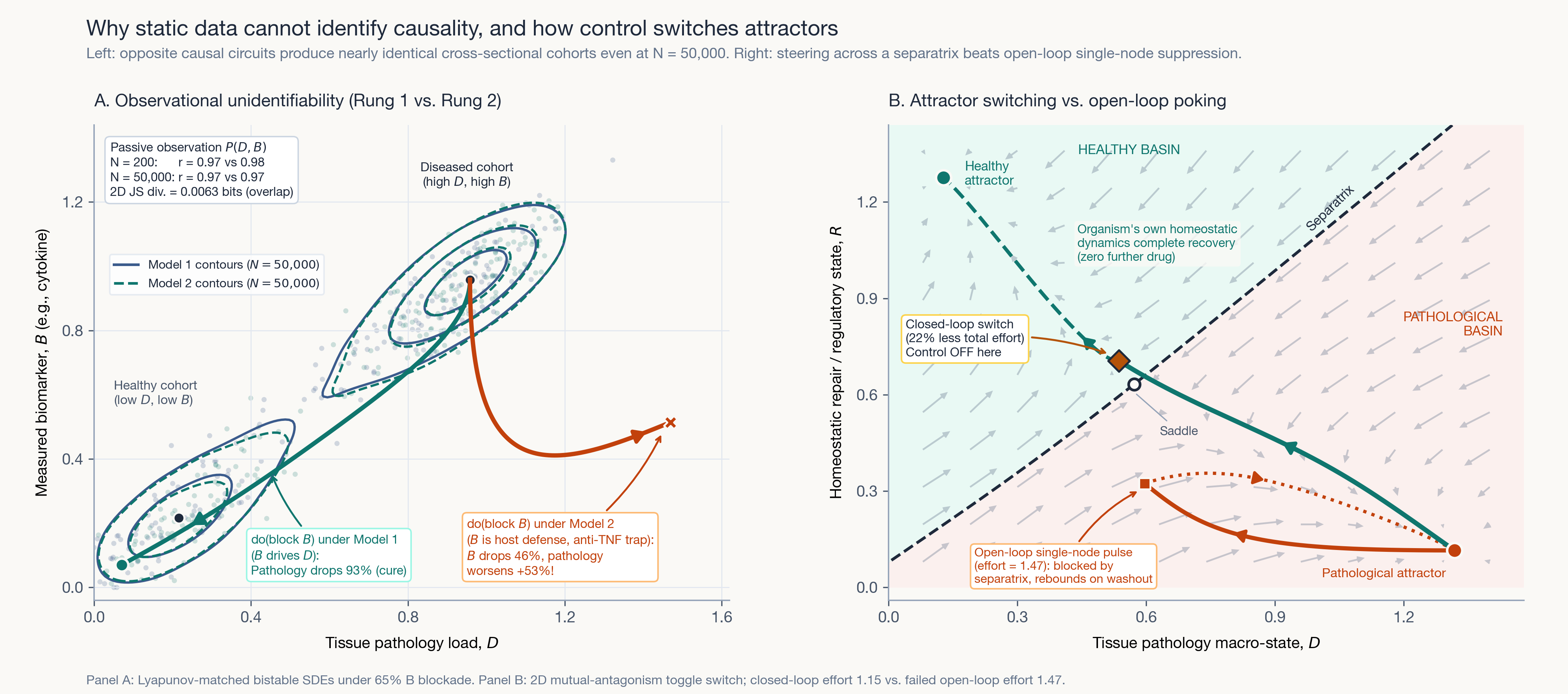
Simulation 3. Left (Panel A): Lyapunov-matched opposite causal SDEs overlap under passive observation at N = 50, 000, yet 65% B blockade cures Model 1 while worsening Model 2. Right (Panel B): an open-loop single-node pulse rebounds on washout, while a closed-loop switch crosses the separatrix with 22% less effort, shuts off, and lets homeostasis complete recovery.
Simulation 3 brings both halves of this argument into one picture. On the left, Panel A puts concrete numbers on Section 4’s observational wall. Tissue pathology D runs horizontally and a circulating biomarker B (like an inflammatory cytokine) runs vertically. Those two overlapping clouds come from 50,000 simulated patients drawn from two Lyapunov-matched bistable SDEs with opposite causal wiring: in Model 1, biomarker B drives pathology D; in Model 2, pathology D induces B as a compensatory host defense, mirroring anti-TNF in septic shock. Passively, the two worlds are virtually indistinguishable (r = 0.974 vs. 0.972, 2D Jensen-Shannon divergence 0.0063 bits). Apply the exact same 65% blockade of B from the diseased cluster: in Model 1 (teal arrow), pathology falls by 92.7%, curing the tissue; in Model 2 (terracotta arrow), biomarker B drops by 46.3% (spotless target engagement) while pathology climbs 53.3% higher.
Look across to Panel B, which shows why knowing causal basin geometry transforms clinical strategy. A two-variable toggle switch couples pathology D against homeostatic repair tone R. The dashed diagonal line through the saddle is the separatrix dividing the pathological basin (bottom right) from the healthy basin (top left), while the small grey arrows show the natural flow of biology with no drug onboard. Starting from the diseased attractor, the terracotta curve shows an open-loop single-node pulse suppressing D alone (effort 1.47). Pathology falls acutely during dosing while never lifting R across the ridge; once the drug washes out (dotted path), native biology pulls the tissue straight back into disease.
Now trace the teal curve: a closed-loop attractor switch aimed perpendicular to the separatrix. It clears the ridge using 22% less total effort (1.15 vs. 1.47). Right at the orange diamond, once safely inside the healthy basin, the controller switches completely off. With zero further drug, the dashed teal trajectory coasts hands-free all the way to the healthy attractor, carried home entirely by evolved homeostasis. Real caveats apply: dense longitudinal time series can sometimes break cross-sectional symmetry in Panel A, and human organs are vastly higher-dimensional, noisier across patients, and toxicity-constrained compared to a 2D phase plane. Clinically, though, the takeaway is clear: chronic single-node suppression fights homeostatic feedback forever and rebounds on withdrawal, whereas attractor switching recruits the body’s own homeostasis to finish recovery.
Why imperfect models are the reason control theory exists
A natural worry follows right away: any biological model we build will be noisy, approximate, and blind to most molecular details inside the cell. If the model is wrong, how can you safely steer a patient with it?
That exact question prompted the second companion essay included below as Appendix B (Right for the Wrong Reasons). The engineering answer surprises outsiders: imperfect models are the entire reason feedback control exists. If our equations were exact with zero drift and zero external disturbances, engineers would precompute open-loop schedules on paper and skip sensors altogether. Most modern infrastructure stays upright (and the more I study engineering, the more amazed I am that anything works at all) using models that are plainly wrong, deployed carefully inside feedback loops.
(Yes, the George Box quote has to show up here; omitting it feels like breaking a guild bylaw.) Everyone recites his 1979 line (“all models are wrong, but some are useful”), though Box’s 1976 JASA paper gave sharper advice: worry selectively about what is importantly wrong, because fretting over mice makes little sense when tigers are abroad.
In Appendix B, I worked through a biochemical signaling cascade (S → R* → P1 → P2 with negative feedback from P2 back onto the receptor) where internal intermediates stay hidden. Training a neural network purely on observed input S and output P2 yields a model that tracks normal data closely yet is “right for the wrong reasons,” illustrating a three-tier Hierarchy of Learnability:
Level 1 (Topology and directionality): The black-box model learns that raising S raises P2, and inside its observed training range it steers accurately to modest targets.
Level 2 (Dynamics and functional form): Push outside the training range, or target a hidden intermediate like P1, and the black box breaks. In Appendix B’s worked control test, aiming near negative-feedback saturation tricks the extrapolating black box into recommending a dose 80% too low. To predict an intervention on a hidden component, you descend to Level 2 by measuring that intermediate and building a Grey-Box model capturing local causal dynamics right where you intervene while leaving distant biology coarse.
Level 3 (Exact microscopic parameters and kinetics): Recovering every true rate constant across an organism is usually blocked by redundancy, sloppiness, and incompressibility.
Computational biology bounces endlessly between Level 1 and Level 3; practical medicine lives at Level 2. In 2005, Michel Gevers (European Journal of Control) formalized this mindset as Identification for Control (I4C): the best model for control minimizes uncertainty along the directions governing closed-loop stability and intervention response, rather than chasing uniform open-loop error across every measured gene.
Once you have a Level 2 Grey-Box model built for control, two workhorse tools let you steer safely despite error. Model Predictive Control (MPC) (Mayne, Rawlings, Rao, and Scokaert, 2000, Automatica; Model Predictive Control, not Model Context Protocol, an acronym collision I grumbled about in Appendix B and still find mildly annoying) plans a constrained trajectory over a receding horizon, executes the first step, measures what the tissue actually did, and re-solves from the new state so feedback absorbs drift continuously. Alongside it, Control Barrier Functions (CBFs) (Ames et al., 2019, ECC) enforce forward-invariant safety sets mathematically, keeping efficacy steering away from physiological cliffs like Notch toxicity or cytokine storm.
Machine learning reached a closely parallel design insight for world models. Yann LeCun (2022) formalized Joint Embedding Predictive Architectures (JEPA) around a simple observation: forcing a generative model to reconstruct every raw pixel in a video wastes huge capacity on unpredictable clutter like wind-blown leaves. Instead, JEPA predicts compressed, abstract latent state transitions under actions. Single-cell perturbation models scored on reconstructing all 20,000 noisy mRNA counts at a single frozen timepoint fall into the exact same pixel-reconstruction trap.
Between chasing 20,000-gene pixel syntax on one end and surrendering to the clinical tyranny of simplicity’s single biomarker cutoff on the other sits what medicine actually needs: a Grey-Box world model predicting compressed physiological trajectories S(t + Δt) = f(S(t), u(t)) under pharmacological input u(t), accurately enough to steer safely across a separatrix.
6. How do you validate a model when human biology is the only oracle?
Suppose we build toward that Grey-Box world model. That lands us on the hardest practical question in biopharma: how do you validate a biological world model before spending $100 million to $300 million reaching Phase II, when living human disease is the only true oracle?
Start by looking plainly at what passes for “target validation” today. Much of early discovery slips into assay circularity. A team spots a differentially expressed gene or literature story, builds a cellular assay or acute mouse model engineered to express that pathway on cue, tests a compound hitting the target, and celebrates when the engineered readout moves. That checks internal consistency: the molecule obeys the local syntax of the assay built to confirm the hypothesis, while the mapping onto chronic human disease stays untested.
That circularity reflects incentives as much as biology. When AstraZeneca audited 142 of its small-molecule programs from 2005 to 2010 (Cook et al., 2014, Nature Reviews Drug Discovery), confirmatory momentum turned up everywhere. The company reorganized around its 5R framework (Right target, Right tissue, Right safety, Right patient, Right commercial potential). In the 2018 follow-up (Nature Reviews Drug Discovery), Paul Morgan and colleagues emphasized the deeper cultural pivot: shifting teams from “progression-seeking” behavior (rewarding milestone passes built on confirmatory assays) to “truth-seeking” behavior (rewarding early falsification experiments that killed flawed hypotheses before Phase III). Across AstraZeneca’s IMED small-molecule portfolio (MedImmune biologics were tracked separately and excluded from that metric), candidate-to-Phase III completion rose from 4% in 2005 to 2010 to 19% in 2012 to 2016. Still, read that jump carefully before giving culture alone the full credit. Morgan and colleagues did not disclose how many projects targeted novel, unprecedented first-in-class mechanisms versus clinically precedented targets, nor did they separate organic internal discovery from acquired or in-licensed assets (even as AstraZeneca’s broader 2010s turnaround leaned heavily on external acquisitions like olaparib and acalabrutinib alongside internal precedented-driver wins like osimertinib). Their own target-class breakdown tells much of the story: active preclinical project volume was roughly halved, kinases surged from 21% to 36% of the portfolio during a major pivot into biomarker-selected oncology, while classic chronic-disease target families shrank sharply (GPCRs fell from 25% to 5%, and ion channels dropped from 8% to 2%). A substantial share of that 4% to 19% leap likely reflects migrating into Regime 1 alongside tighter denominator pruning, though diagnosing and breaking progression-seeking circularity remains one of the clearest organizational lessons in modern pharma.
Do not starve the clinic of ground truth
Experienced clinicians immediately flag a serious risk here. Turn biological world models into a bureaucratic preclinical tollbooth demanding near-certainty before a drug enters humans, and we make two huge mistakes: we starve our models of the only human causal ground truth that can calibrate them, and we extinguish clinical serendipity.
Medical history shows how often living human physiology surprises us. Pfizer developed sildenafil for angina; anti-anginal activity in 1991 to 1992 human studies proved modest, while male volunteers reported unexpected erections, pivoting the drug to erectile dysfunction (Goldstein et al., 1998, NEJM) and later pulmonary arterial hypertension. Minoxidil failed for gastric ulcers, became an oral hypertension drug in 1979, triggered pronounced hair growth in patients, and won topical alopecia approval in 1988. And thalidomide, infamous for tragic teratogenicity as a 1950s sedative, re-entered medicine after Jacob Sheskin (1965) saw it clear severe inflammatory lesions in leprosy patients given it for sleep, later winning repurposing in refractory multiple myeloma (Singhal et al., 1999, NEJM) and spawning lenalidomide; only after clinical proof did Takumi Ito and colleagues (2010, Science) identify cereblon (CRBN), founding E3 ubiquitin ligase molecular glues.
A subtler version of that lesson is unfolding today with GLP-1 receptor agonists. When John Eng and colleagues (1992) isolated exendin-4 from Gila monster venom, GLP-1 was viewed primarily as a glucose-dependent pancreatic incretin. By the time exenatide won Type 2 diabetes approval in 2005, though, extra-pancreatic physiology was hardly a total mystery: early human and animal studies had already demonstrated gastric slowing (Wettergren et al., 1993), central and human satiety signaling (Turton et al., 1996; Flint et al., 1998), and acute cardioprotective signals (Nikolaidis et al., 2004; Bose et al., 2005). Much of the class’s multi-organ benefit clearly flows through sustained weight loss, lower blood pressure, and dampened systemic inflammation. Yet even with those clues on the table, no early preclinical model foresaw the clinical magnitude long-acting agonists would deliver across non-diabetic cardiovascular disease (SELECT, cutting major cardiovascular events by 20%; Lincoff et al., 2023), diabetic chronic kidney disease (FLOW, cutting major kidney and cardiovascular events by 24%; Perkovic et al., 2024), MASH, sleep apnea, and heart failure with preserved ejection fraction. Better still, a 2026 formal mediation analysis of SELECT (Colhoun et al., 2026) found that all measured conventional risk factors combined (body weight, waist circumference, blood pressure, HbA1c, lipids, renal markers, and hs-CRP) statistically explain only about a third (31.4%) of semaglutide’s cardiovascular protection, leaving roughly two-thirds still pointing to unmeasured or direct human biology.
Running thoughtful human experiments early is essential, because human physiology keeps revealing mechanisms our preclinical assumptions miss. The real scandal in biopharma is running epistemically sterile Phase II trials.
Watch a typical Phase II failure play out. A sponsor enrolls hundreds of patients, tests a drug against a noisy composite endpoint, misses p < 0.05, shelves the asset in a terse press release, and locks the pharmacokinetics, target engagement, and longitudinal biomarkers inside corporate archives. Patients assumed real risk, capital evaporated, and our shared model of human disease learned almost nothing about why the drug missed. Did tissue exposure fall short? Did a parallel feedback loop buffer the blockade? Did one biological endotype respond sharply while three others swamped the average?
Contrast that dead end with one of the best rescues in modern clinical medicine: mepolizumab (anti-IL-5) in severe asthma. In early all-comer asthma studies (Leckie et al., 2000, The Lancet; Flood-Page et al., 2007, AJRCCM), mepolizumab wiped out blood and sputum eosinophils while completely missing standard lung-function (FEV1) and airway hyper-responsiveness endpoints. Under standard binary go/no-go logic, IL-5 looked like a textbook “colorless green” target: verified target engagement, zero clinical efficacy, case closed.
Instead of burying the biology, investigators actually listened to the human perturbation data. Two small, deeply phenotyped human trials published back-to-back in NEJM in March 2009 updated both the patient endotype (steroid-refractory asthma with persistent sputum eosinophilia) and the readout (severe exacerbations and oral steroid sparing instead of baseline bronchoconstriction). Pranab Haldar and colleagues (2009, just n = 61 patients) cut severe exacerbations from 3.4 to 2.0 per patient. Parameswaran Nair and colleagues (2009, just n = 20 patients) cut exacerbations from 12 down to 1 while letting patients reduce oral prednisone by 83.8% versus 47.7% on placebo. Just eighty-one carefully studied humans updated the asthma world model, separated eosinophil-driven exacerbations from baseline airway tone, and launched an approved biologic class.
Bootstrapping the cross-scale transfer function
If living human biology is our only oracle, how do we bootstrap the cross-scale transfer function connecting preclinical latent spaces to human clinical trajectories? Three concrete pipelines already exist in partial form, and looking at them closely exposes where the plumbing is still broken.
First, mining the Phase II graveyard, with eyes open to both the legacy data limits and the game theory. Industry and academia have built valuable repositories that deserve credit: TransCelerate BioPharma’s Historical Trial Data (HTD) pools records across more than 95,000 patients; Project Data Sphere hosts over 205 to 255 oncology trial datasets (>260,000 patient-lives); Vivli lists over 6,200 shareable trials (~3.6 million to 6.4 million participants); and Yale’s YODA Project mediates access to Johnson & Johnson clinical study reports and individual participant data.
Now look at which arms sit inside those public repositories. TransCelerate HTD and Project Data Sphere overwhelmingly share placebo and standard-of-care control arms, while YODA’s primary policy covers Phase II through IV trials of approved products. Terminated, unapproved Phase II investigational drug arms (the studies where we confirmed target engagement in humans, tracked patient responses, and watched clinical outcomes stay flat) remain locked inside corporate sponsors. (Sharing placebo arms is useful, of course, though it mostly builds a richer library of untreated disease, which was rarely the missing causal answer we spent a hundred million dollars to uncover.)
Those internal Phase II archives matter enormously right now. Every terminated Phase II program cost tens to hundreds of millions of dollars to generate a real human do(X) perturbation experiment that nobody can replicate quickly in a cell line. As frontier AI labs move aggressively into biology (Anthropic’s life-sciences push is only the latest example), proprietary libraries of failed human interventional trials represent arguably big pharma’s strongest structural advantage over pure AI labs, provided pharma actually organizes and learns from them.
Keep expectations realistic about what actually sits in those legacy freezers and folders, though. Older Phase II trials were built to clear regulatory endpoints on tight budgets using yesterday’s measurement technology. Almost none ran single-cell RNA-seq or spatial proteomics; a handful banked occasional tissue biopsies, while most kept only urine, whole blood, and plasma collected for basic pharmacokinetics, safety panels, and routine metabolite checks. Useful causal priors (and modern plasma proteomics on banked samples) can still come out of that archive, even while future trials need far richer longitudinal sampling. And be clear-eyed about the game theory behind why those failed arms stay private: moralizing about “data silos” misses basic competitive incentives. Publishing expensive negative human perturbation data openly hands rivals a free map of biological dead ends they never had to pay $200 million to discover. Rational strategy favors retaining and compounding that negative human perturbation data internally rather than subsidizing an opponent. The real waste is less refusing to give those trials away than letting them gather dust unread inside your own firewall.
Second, lean human experimental medicine, adaptive platforms, and deeply phenotyped longitudinal cohorts. Rather than treating Phase II as a late binary lottery, sponsors can run smaller, biomarker-dense Phase 0, Ib, and IIa perturbation trials designed specifically to measure human dynamic trajectories and calibrate cross-scale transfer maps, turning Gevers’s Identification-for-Control into clinical practice. Standing Bayesian adaptive platforms like I-SPY 2 in neoadjuvant breast cancer (Barker et al., 2009; demonstrated with neratinib in Park et al., 2016, NEJM) pair a shared control arm with rapid pathological complete response readouts, serial MRI, and biopsies, routing patients toward responsive signatures and dropping dead ends early.
Just as valuable, and far easier to scale, are deeply phenotyped longitudinal observational cohorts. Much of the human dynamical data medicine is missing does not require dosing an experimental molecule or altering a patient’s clinical management at all. By layering richer modern measurements (serial plasma proteomics, longitudinal immune and single-cell profiling, quantitative imaging, and continuous physiological sensors) directly onto normal standard-of-care management and routine clinical monitoring, we can actually watch human disease evolve inside the same individuals across months and years. Instead of guessing from a single cross-sectional snapshot or forcing fifty years into fourteen days in a mouse, longitudinal deep phenotyping during routine care lets us see which homeostatic buffering systems fail first, when patients begin tipping across a separatrix, and how distinct human endotypes respond to standard-of-care perturbations already happening in the clinic every day.
Third, natural and real-world human perturbations. Recall-by-Genotype (RbG) studies (Corbin et al., 2018, Nature Communications) re-contact carriers of rare loss-of-function variants from large biobanks (such as the NIHR BioResource with over 300,000 volunteers, UK Biobank, or FinnGen) for targeted physiological challenge tests rather than passive record pulls. Danish Saleheen and colleagues (2017, Nature), for example, recalled homozygous human APOC3 knockouts for oral fat-tolerance challenges, proving in living humans that complete loss of APOC3 sharply blunts post-meal triglyceride spikes without liver toxicity. Across all three pipelines, one ethical duty stays non-negotiable: clinical trial records and recall cohorts are never inert ML benchmarks. Every data point is a consenting human patient who assumed risk or shared personal biology, bringing serious obligations around informed consent, privacy, governance, and return of findings.
Four epistemic tests for a biological world model
With human ground truth anchoring the outer loop, what should a biological world model clear before a program commits to Phase II? Figure 1 summarizes the shift from open-loop syntactic confirmation to closed-loop falsification, operationalized through four concrete epistemic tests.
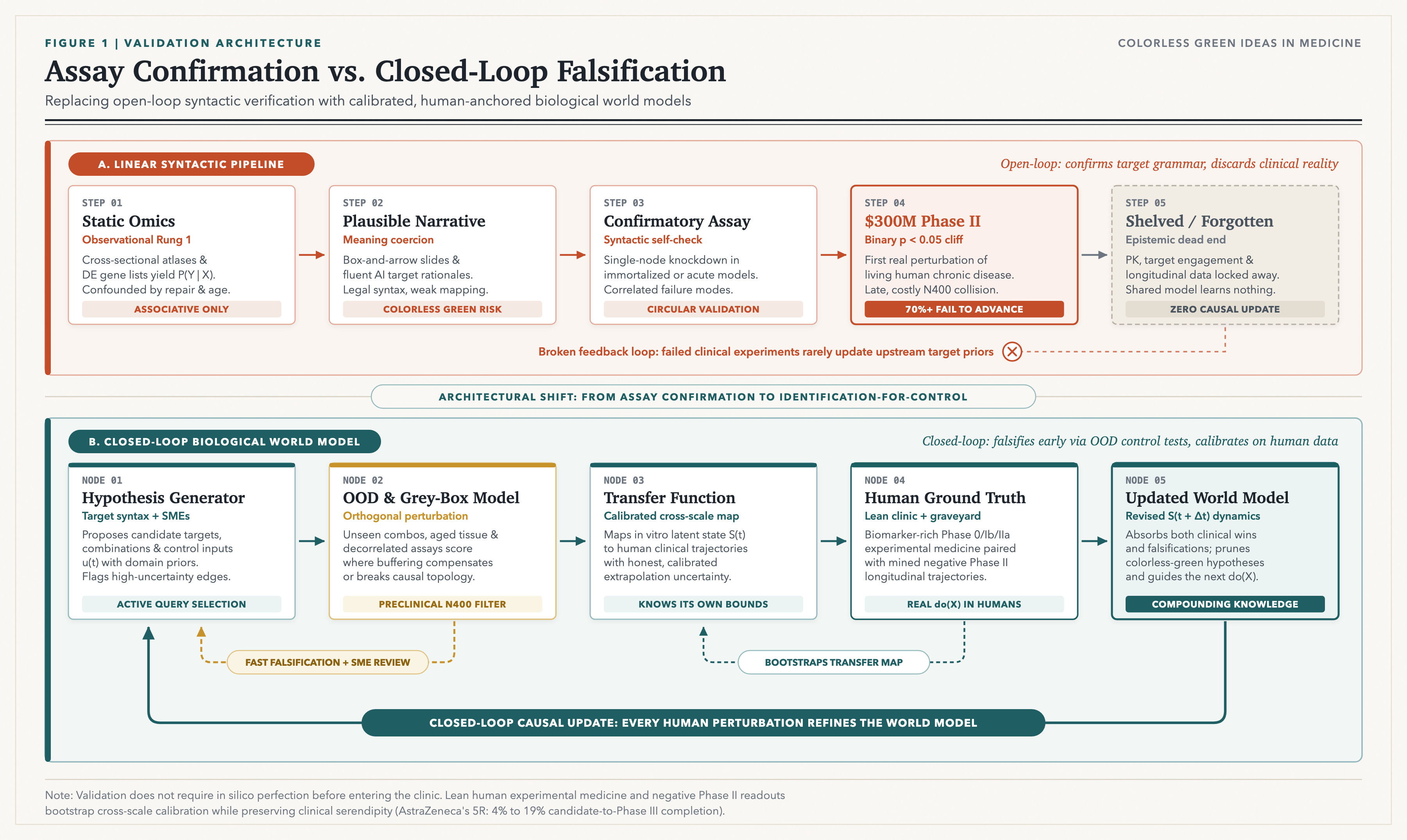
Figure 1. Assay confirmation checks whether a target obeys the local grammar of the model built to support it. Closed-loop falsification pairs orthogonal out-of-distribution preclinical tests with lean human experimental medicine and negative Phase II readouts so every perturbation updates the shared world model.
Test 1: Out-of-distribution interventional surprise. Stop scoring models on held-out wells of the same immortalized cell line at 72 hours. Evaluate them prospectively on unseen drug and gene combinations, multi-timepoint trajectories, and aged or comorbid primary human tissues, asking whether the model predicts where homeostatic buffering compensates or breaks. Remember Appendix B‘s structural perturbation test: a black-box mimic tracked normal dynamics closely and collapsed once an internal degradation rate shifted. Predicting when a target fails through network compensation is a far tougher benchmark than confirming an expected hit.
Test 2: Orthogonal assay decorrelation. Operationalize Scannell and Bosley (2016) and Simulation 1, Panel B from Section 3 inside preclinical gating. Require orthogonal readouts whose error modes do not correlate. Remember the arithmetic: just two orthogonal assays (r_err = 0.10, validity 0.50) reached 18.6% PPV, beating an infinite chain of assays sharing 85% error variance (capped at 11.3% PPV). Stacking five assays sharing the same acute-overexpression artifact buys internal comfort while leaving clinical validity pinned near the floor.
Test 3: Calibrated cross-scale uncertainty. Any transfer function mapping in vitro or animal latent states S(t) to human clinical trajectories must output calibrated uncertainty bounds flagging when a hypothesis steps outside its training support. Look back to Appendix B‘s two control scenarios: the same imperfect model steered accurately inside its interpolation zone (Scenario B) and under-dosed by 80% near negative-feedback saturation (Scenario A). A model warning “extrapolation regime: no prior human perturbations in this aged tissue endotype” protects capital and patients far better than an uncalibrated score hiding the cliff until Phase II.
Test 4: Closed-loop active falsification with domain experts in the loop. Turn Gevers’s (2005) experiment-design insight into an active wet-lab workflow using sequential optimal experimental design (OED). How does that work on the bench? Instead of screening thousands of genes uniformly, the model inspects its highest-uncertainty causal edges, asks “which perturbation will best separate competing mechanistic explanations or break my current prediction?”, runs that experiment, absorbs the surprise, and chooses the next perturbation. Early results show real leverage: IterPert (Huang et al., 2024, RECOMB) applied sequential OED to Perturb-seq screens and matched leading active-learning accuracy using only one-third as many perturbations. Going further, BioDiscoveryAgent (Roohani et al., 2025, ICLR) used an LLM agent to propose iterative genetic screens, reporting a 21% average gain over Bayesian optimization baselines (46% on harder non-essential targets).
Keep the methodological caveat right next to BioDiscoveryAgent. It was evaluated retrospectively in silico on historical benchmarks where decades of published papers overlap heavily with known pathways, so prior text leakage does real lifting. In truly novel Regime 2 chronic disease, where literature is thin or misleading, autonomous agents happily generate fluent scientific slop unless deep domain subject-matter experts (SMEs) stay inside the falsification loop to interrogate assumptions and spot biological impossibilities early (Branson, 2026). Automation brings search breadth and speed; domain expertise and wet-lab falsification keep the loop anchored to physical reality.
7. Keeping grammar coupled to a world model
It feels right to end back where this essay began, with Noam Chomsky’s five strange words from 1957: “Colorless green ideas sleep furiously.” The sentence parses effortlessly and satisfies every rule of English grammar, yet the instant you actually think about what it claims, your N400 system fires, your world model steps in, and the claim gets falsified on the spot. Human cognition never evolved syntax floating free of reality. It pairs compositional freedom (which lets us assemble unfamiliar hypotheses and counterfactuals) with a live world model that immediately tests those claims, falsifies the broken ones, and updates itself when physical evidence forces it to stretch.
Medicine needs both halves working together. We do not want a timid, hyper-defensive biology that only repeats safe Regime 1 sentences we already know how to parse. Look back at three breakthroughs of recent decades, each clashing sharply with the prevailing biological world model of its era until hard experimental evidence forced that world model to expand:
Checkpoint immunotherapy argued that instead of poisoning tumor cells directly, we should release physiological brakes on T cells and let the patient’s own immune system clear the cancer (pioneered by James Allison and Tasuku Honjo).
mRNA therapeutics took a notoriously fragile, strongly immunogenic nucleic acid and turned it into a clinical medicine by modifying its nucleosides so innate immune sensors stand down (pioneered by Katalin Karikó and Drew Weissman).
Cellular reprogramming reversed supposedly terminal adult cell fate back to pluripotency using just four transcription factors (Takahashi and Yamanaka, 2006), the exact surprise that cracked the 80% linear driver-node paradox in Section 5.
Every one of those ideas looked impossible until biology’s world model stretched wide enough to hold it. Building biological world models means restoring the missing half of the cognitive pair rather than throttling imagination or slowing down AI-assisted hypothesis generation. Let the syntax engines run. What medicine has been missing is a fast, calibrated, human-anchored biological N400: a working world model grounded tightly enough in living physiology that our “colorless green” targets collide with reality in silicon, in orthogonal primary human tissues, and in lean human experimental medicine long before they ever reach Phase II patients.
Even as the field builds toward that closed-loop architecture, two hard scientific questions remain open, and I do not think anyone has easy answers to them yet:
How compressed can a biological world model be while staying predictive across real human heterogeneity? Microscopic whole-organism simulation is out of reach, and flattening chronic disease to one scalar biomarker cutoff fails patients. We still do not know the minimum latent state space that survives real human genetics, immune history, comorbidity, and aging.
Which single homeostatic buffering systems can be selectively perturbed to bend biological time without rewriting causal topology? Pressing on multiple buffers at once produces fast answers to the wrong disease. Identifying the single buffer whose breakdown reproduces a specific human endotype remains one of the deepest experimental and causal-inference puzzles in translational science.
Frontier models can now draft a spotless, citation-dense target dossier in thirty seconds, which means biology is about to generate grammatically flawless hypotheses faster than we could ever test them in the clinic. There is nothing wrong with letting machines dream up colorless green ideas at scale, provided we finally build the world models that can catch them before they grow into $300 million clinical trials. Until then, the ideas will keep sleeping furiously, and living human physiology will keep waking us up in Phase II.
For readers who want to go deeper into the foundations behind Sections 4 and 5, two earlier companion essays from October 2025 appear in full after the references below. Appendix A (We may never understand biology, and machine learning may not either, but maybe it won’t matter) unpacks algorithmic incompressibility, computational irreducibility, chaotic dynamics, and the 6-gene repressilator inference barrier. Appendix B (Right for the Wrong Reasons) walks through the hidden-state biochemical signaling ODE, the Hierarchy of Learnability, the interpolation-versus-extrapolation control failure, and the move from Black-Box mimics to Grey-Box models.
Author’s note: I used Gemini Neon to help assemble this manuscript and write some sections for clarity, but the research directions and argument are my own.
References
Adduri, A. K., Gautam, D., Bevilacqua, B., ..., Hsu, P. D., Goodarzi, H., & Roohani, Y. H. (2026). Predicting cellular responses to perturbation across diverse contexts with State. Cell, 189(19), 5914 to 5931.e20. https://doi.org/10.1016/j.cell.2026.07.052
Adler, M., Mayo, A., Zhou, X., Franklin, R. A., Meizlish, M. L., Medzhitov, R., Kallenberger, S. M., & Alon, U. (2020). Principles of cell circuits for tissue repair and fibrosis. iScience, 23(2), 100841. https://doi.org/10.1016/j.isci.2020.100841
Ahlmann-Eltze, C., Huber, W., & Anders, S. (2025). Deep-learning-based gene perturbation effect prediction does not yet outperform simple linear baselines. Nature Methods, 22(8), 1657 to 1661. https://doi.org/10.1038/s41592-025-02772-6
Ames, A. D., Coogan, S., Egerstedt, M., Notomista, G., Sreenath, K., & Tabuada, P. (2019). Control barrier functions: Theory and applications. 2019 18th European Control Conference (ECC), 3420 to 3431. https://doi.org/10.23919/ECC.2019.8796030
Ashby, W. R. (1956). An Introduction to Cybernetics. London: Chapman & Hall.
Bareinboim, E., Correa, J. D., Ibeling, D., & Icard, T. F. (2022). On Pearl’s hierarchy and the foundations of causal inference. In Probabilistic and Causal Inference: The Works of Judea Pearl (ACM Books). https://doi.org/10.1145/3501714.3501743
Barker, A. D., et al. (2009). I-SPY 2: An adaptive breast cancer trial design in the setting of neoadjuvant chemotherapy. Clinical Pharmacology & Therapeutics, 86(1), 97 to 100. https://doi.org/10.1038/clpt.2009.68
Barter, P. J., Caulfield, M., Eriksson, M., et al. (2007). Effects of torcetrapib in patients at high risk for coronary events. New England Journal of Medicine, 357(21), 2109 to 2122. https://doi.org/10.1056/NEJMoa0706628
Bender, E. M., & Koller, A. (2020). Climbing towards NLU: On Meaning, Form, and Understanding in the Age of Data. Proceedings of the 58th Annual Meeting of the Association for Computational Linguistics (ACL 2020), 5185 to 5198. https://aclanthology.org/2020.acl-main.463/
BIO, Informa Pharma Intelligence, & QLS Advisors (2021). Clinical Development Success Rates and Contributing Factors 2011 to 2020. Industry Report.
Bose, A. K., Mocanu, M. M., Carr, R. D., Brand, C. L., & Yellon, D. M. (2005). Glucagon-like peptide 1 can directly protect the heart against ischemia/reperfusion injury. Diabetes, 54(1), 146 to 151. https://doi.org/10.2337/diabetes.54.1.146
Bowman, L., Hopewell, J. C., Chen, F., et al. (HPS3/TIMI55-REVEAL Collaborative Group) (2017). Effects of anacetrapib in patients with atherosclerotic vascular disease. New England Journal of Medicine, 377(13), 1217 to 1227. https://doi.org/10.1056/NEJMoa1706444
Box, G. E. P. (1976). Science and statistics. Journal of the American Statistical Association, 71(356), 791 to 799. https://doi.org/10.1080/01621459.1976.10480949
Box, G. E. P. (1979). Robustness in the strategy of scientific model building. In R. L. Launer & G. N. Wilkinson (Eds.), Robustness in Statistics (pp. 201 to 236). New York: Academic Press. https://doi.org/10.1016/B978-0-12-438150-6.50018-2
Branson, K. (2026, June). Science slop at scale, or how I learned to stop worrying and embrace the SME. https://www.linkedin.com/pulse/science-slop-scale-how-i-learned-stop-worrying-embrace-kim-branson-k07pc/
Brenner, S. (2010). Sequences and consequences. Philosophical Transactions of the Royal Society B: Biological Sciences, 365(1537), 207 to 212. https://doi.org/10.1098/rstb.2009.0221
Bunne, C., Roohani, Y., Rosen, Y., ..., Regev, A., Leskovec, J., Quake, S. R., et al. (2024). How to build the virtual cell with artificial intelligence: Priorities and opportunities. Cell, 187(25), 7045 to 7063. https://doi.org/10.1016/j.cell.2024.11.015
Cho, L., Nicholls, S. J., Frndak, S., Wolski, K., Nordestgaard, B. G., ..., Tsimikas, S., ..., Nissen, S. E., et al. (2026). Pelacarsen and cardiovascular outcomes in patients with high lipoprotein(a). New England Journal of Medicine (published online November 7, 2026). https://doi.org/10.1056/NEJMoa2610159
Chomsky, N. (1956). Three models for the description of language. IRE Transactions on Information Theory, 2(3), 113 to 124. https://doi.org/10.1109/TIT.1956.1056813
Chomsky, N. (1957). Syntactic Structures. The Hague: Mouton & Co., pp. 15 to 16.
Clarke, R., Peden, J. F., Hopewell, J. C., et al. (2009). Genetic variants associated with Lp(a) lipoprotein level and coronary disease. New England Journal of Medicine, 361(26), 2518 to 2528. https://doi.org/10.1056/NEJMoa0902604
Colhoun, H. M., Deanfield, J., et al. (2026). Semaglutide and cardiovascular risk reduction: a mediation analysis of the SELECT trial. European Heart Journal. https://doi.org/10.1093/eurheartj/ehag524
Conant, R. C., & Ashby, W. R. (1970). Every good regulator of a system must be a model of that system. International Journal of Systems Science, 1(2), 89 to 97. https://doi.org/10.1080/00207727008920220
Cook, D., Brown, D., Alexander, R., March, R., Morgan, P., Satterthwaite, G., & Pangalos, M. N. (2014). Lessons learned from the fate of AstraZeneca’s drug pipeline: A five-dimensional framework. Nature Reviews Drug Discovery, 13(6), 419 to 431. https://doi.org/10.1038/nrd4309
Corbin, L. J., Tan, V. Y., Hughes, D. A., et al. (2018). Formalising recall by genotype as an efficient approach to detailed phenotyping and causal inference. Nature Communications, 9(1), 711. https://doi.org/10.1038/s41467-018-03109-y
Cornelius, S. P., Kath, W. L., & Motter, A. E. (2013). Realistic control of network dynamics. Nature Communications, 4, 1942. https://doi.org/10.1038/ncomms2939
Coussens, L. M., Fingleton, B., & Matrisian, L. M. (2002). Matrix metalloproteinase inhibitors and cancer: trials and tribulations. Science, 295(5564), 2387 to 2392. https://doi.org/10.1126/science.1067100
Cummings, J. L., Morstorf, T., & Zhong, K. (2014). Alzheimer’s disease drug-development pipeline: few candidates, frequent failures. Alzheimer’s Research & Therapy, 6(4), 37. https://doi.org/10.1186/alzrt269
DiMasi, J. A., Grabowski, H. G., & Hansen, R. W. (2016). Innovation in the pharmaceutical industry: New estimates of R&D costs. Journal of Health Economics, 47, 20 to 33. https://doi.org/10.1016/j.jhealeco.2016.01.012
Doody, R. S., Raman, R., Farlow, M., et al. (2013). A phase 3 trial of semagacestat for treatment of Alzheimer’s disease. New England Journal of Medicine, 369(4), 341 to 350. https://doi.org/10.1056/NEJMoa1210951
Echt, D. S., Liebson, P. R., Mitchell, L. B., et al. (CAST Investigators) (1991). Mortality and morbidity in patients receiving encainide, flecainide, or placebo. New England Journal of Medicine, 324(12), 781 to 788. https://doi.org/10.1056/NEJM199103213241201
Eder, J., Sedrani, R., & Wiesmann, C. (2014). The discovery of first-in-class drugs: origins and evolution. Nature Reviews Drug Discovery, 13(8), 577 to 587. https://doi.org/10.1038/nrd4336
Egan, M. F., Kost, J., Tariot, P. N., et al. (2018). Randomized trial of verubecestat for mild-to-moderate Alzheimer’s disease. New England Journal of Medicine, 378(18), 1691 to 1703. https://doi.org/10.1056/NEJMoa1706441
Egan, M. F., Kost, J., Voss, T., et al. (2019). Randomized trial of verubecestat for prodromal Alzheimer’s disease. New England Journal of Medicine, 380(15), 1408 to 1420. https://doi.org/10.1056/NEJMoa1812840
Eng, J., et al. (1992). Isolation and characterization of exendin-4, an exendin-3 analogue, from Heloderma suspectum venom. Journal of Biological Chemistry, 267(11), 7402 to 7405. https://doi.org/10.1016/S0021-9258(18)42531-8
Fisher, C. J., Jr., Agosti, J. M., Opal, S. M., et al. (1996). Treatment of septic shock with the tumor necrosis factor receptor:Fc fusion protein. New England Journal of Medicine, 334(26), 1697 to 1702. https://doi.org/10.1056/NEJM199606273342603
Flint, A., Raben, A., Astrup, A., & Holst, J. J. (1998). Glucagon-like peptide 1 promotes satiety and suppresses energy intake in humans. Journal of Clinical Investigation, 101(3), 515 to 520. https://doi.org/10.1172/JCI990
Flood-Page, P., et al. (2007). A study to evaluate safety and efficacy of mepolizumab in patients with moderate persistent asthma. American Journal of Respiratory and Critical Care Medicine, 176(11), 1062 to 1071. https://doi.org/10.1164/rccm.200701-085OC
Francis, B. A., & Wonham, W. M. (1976). The internal model principle of control theory. Automatica, 12(5), 457 to 465. https://doi.org/10.1016/0005-1098(76)90006-6
Gerstein, H. C., Miller, M. E., Byington, R. P., et al. (ACCORD Study Group) (2008). Effects of intensive glucose lowering in type 2 diabetes. New England Journal of Medicine, 358(24), 2545 to 2559. https://doi.org/10.1056/NEJMoa0802743
Gevers, M. (2005). Identification for control: From the early achievements to the revival of experiment design. European Journal of Control, 11(4 to 5), 335 to 352. https://doi.org/10.3166/ejc.11.335-352
Goldstein, I., et al. (1998). Oral sildenafil in the treatment of erectile dysfunction. New England Journal of Medicine, 338(20), 1397 to 1404. https://doi.org/10.1056/NEJM199805143382001
Goodwin, L. O., Splinter, E., Davis, T. L., et al. (2019). Large-scale discovery of mouse transgenic integration sites reveals frequent structural variation and insertional mutagenesis. Genome Research, 29(3), 494 to 505. https://doi.org/10.1101/gr.233866.117
Hagoort, P., Hald, L., Bastiaansen, M., & Petersson, K. M. (2004). Integration of word meaning and world knowledge in language comprehension. Science, 304(5669), 438 to 441. https://doi.org/10.1126/science.1095455
Haldar, P., et al. (2009). Mepolizumab and exacerbations of refractory eosinophilic asthma. New England Journal of Medicine, 360(10), 973 to 984. https://doi.org/10.1056/NEJMoa0808991
Harrison, R. K. (2016). Phase II and phase III failures: 2013 to 2015. Nature Reviews Drug Discovery, 15(12), 817 to 818. https://doi.org/10.1038/nrd.2016.184
Hollander, J. (1971). Coiled Alizarine (for Noam Chomsky). In The Night Mirror. New York: Atheneum.
Huang, K., Lopez, R., Hütter, J.-C., Kudo, T., Rios, A., & Regev, A. (2024). Sequential optimal experimental design of perturbation screens guided by multi-modal priors (IterPert). RECOMB 2024 (pp. 17 to 37). Springer LNCS. https://doi.org/10.1007/978-1-0716-3989-4_2
IL6R Genetics Consortium and Emerging Risk Factors Collaboration (2012). Interleukin-6 receptor pathways in coronary heart disease: a collaborative meta-analysis of 82 studies. The Lancet, 379(9822), 1205 to 1213. https://doi.org/10.1016/S0140-6736(11)61931-4
Ito, T., et al. (2010). Identification of a primary target of thalidomide teratogenicity. Science, 327(5971), 1345 to 1350. https://doi.org/10.1126/science.1177319
Jakobson, R. (1959). Boas’ view of grammatical meaning. In W. Goldschmidt (Ed.), The Anthropology of Franz Boas, American Anthropological Association Memoir 89, pp. 139 to 145.
Jonsson, T., Atwal, J. K., Steinberg, S., et al. (2012). A mutation in APP protects against Alzheimer’s disease and age-related cognitive decline. Nature, 488(7409), 96 to 99. https://doi.org/10.1038/nature11283
Jumper, J., Evans, R., Pritzel, A., et al. (2021). Highly accurate protein structure prediction with AlphaFold. Nature, 596(7873), 583 to 589. https://doi.org/10.1038/s41586-021-03819-2
Kamstrup, P. R., Tybjærg-Hansen, A., Steffensen, R., & Nordestgaard, B. G. (2009). Genetically elevated lipoprotein(a) and increased risk of myocardial infarction. JAMA, 301(22), 2331 to 2339. https://doi.org/10.1001/jama.2009.801
Katz, J. J., & Fodor, J. A. (1963). The structure of a semantic theory. Language, 39(2), 170 to 210. https://doi.org/10.2307/411200
Kutas, M., & Federmeier, K. D. (2011). Thirty years and counting: Finding meaning in the N400 component of the event-related brain potential (ERP). Annual Review of Psychology, 62, 621 to 647. https://doi.org/10.1146/annurev.psych.093008.131123
Kutas, M., & Hillyard, S. A. (1980). Reading senseless sentences: Brain potentials reflect semantic incongruity. Science, 207(4427), 203 to 205. https://doi.org/10.1126/science.7350657
Lazebnik, Y. (2002). Can a biologist fix a radio? Or, what I learned while studying apoptosis. Cancer Cell, 2(3), 179 to 182. https://doi.org/10.1016/S1535-6108(02)00133-2
Leckie, M. J., et al. (2000). Effects of an interleukin-5 blocking monoclonal antibody on eosinophils, airway hyper-responsiveness, and the late asthmatic response. The Lancet, 356(9248), 2144 to 2148. https://doi.org/10.1016/s0140-6736(00)03496-6
LeCun, Y. (2022). A path towards autonomous machine intelligence. OpenReview.
https://openreview.net/forum?id=BZ5a1r-kVsf
Li, K., Hopkins, A. K., Bau, D., Viégas, F. B., Pfister, H., & Wattenberg, M. (2023). Emergent world representations: Exploring a sequence model trained on a synthetic task. ICLR 2023. https://arxiv.org/abs/2210.13382
Lincoff, A. M., et al. (2023). Semaglutide and cardiovascular outcomes in obesity without diabetes (SELECT). New England Journal of Medicine, 389(24), 2221 to 2232. https://doi.org/10.1056/NEJMoa2307563
Lincoff, A. M., Nicholls, S. J., Riesmeyer, J. S., et al. (2017). Evacetrapib and cardiovascular outcomes in high-risk vascular disease. New England Journal of Medicine, 376(20), 1933 to 1942. https://doi.org/10.1056/NEJMoa1609581
Liu, Q., Zhang, Q., Du, J.-H., Zhao, S., & Wang, J. (2025). Effects of distance metrics and scaling on the perturbation discrimination score. arXiv:2511.16954. https://arxiv.org/abs/2511.16954
Liu, Y.-Y., Slotine, J.-J., & Barabási, A.-L. (2011). Controllability of complex networks. Nature, 473(7346), 167 to 173. https://doi.org/10.1038/nature10011
Liu, Y.-Y., Slotine, J.-J., & Barabási, A.-L. (2011). Liu et al. reply. Nature, 478(7369), E4 to E5. https://doi.org/10.1038/nature10544
Long, E., & Zhang, J. (2023). Evidence for the role of selection for reproductively advantageous alleles in human aging. Science Advances, 9(49), eadh4990. https://doi.org/10.1126/sciadv.adh4990
Mayne, D. Q., Rawlings, J. B., Rao, C. V., & Scokaert, P. O. M. (2000). Constrained model predictive control: Stability and optimality. Automatica, 36(6), 789 to 814. https://doi.org/10.1016/S0005-1098(99)00214-9
Medawar, P. B. (1952). An Unsolved Problem of Biology. London: H. K. Lewis & Co.
Miller, H. E., Mejia, G. M., Leblanc, F. J. A., Swain, B., Wang, B., & Camillo, L. P. L. (2026). Deep learning perturbation models can outperform baselines on calibrated metrics. Nature Biotechnology (online October 1, 2026). https://doi.org/10.1038/s41587-026-03307-w
Minikel, E. V., Painter, J. L., Dong, C. C., & Nelson, M. R. (2024). Refining the impact of genetic evidence on clinical success. Nature, 629(8012), 624 to 629. https://doi.org/10.1038/s41586-024-07316-0
Morgan, P., Brown, D. G., Lennard, S., et al. (2018). Impact of a five-dimensional framework on R&D productivity at AstraZeneca. Nature Reviews Drug Discovery, 17(3), 167 to 181. https://doi.org/10.1038/nrd.2017.244
Müller, F.-J., & Schuppert, A. (2011). Few inputs can reprogram biological networks. Nature, 478(7369), E4. https://doi.org/10.1038/nature10543
Nair, P., et al. (2009). Mepolizumab for prednisone-dependent asthma with sputum eosinophilia. New England Journal of Medicine, 360(10), 985 to 993. https://doi.org/10.1056/NEJMoa0805435
Nanda, N., Lee, A., & Wattenberg, M. (2023). Emergent linear representations in world models of self-supervised sequence models. BlackboxNLP 2023. https://arxiv.org/abs/2309.00941
Nicholls, S. J., Nelson, A. J., Ditmarsch, M., et al. (2025). Safety and efficacy of obicetrapib in patients at high cardiovascular risk. New England Journal of Medicine, 393(1), 51 to 61. https://doi.org/10.1056/NEJMoa2415820
Nieuwland, M. S., & Van Berkum, J. J. A. (2006). When peanuts fall in love: N400 evidence for the power of discourse. Journal of Cognitive Neuroscience, 18(7), 1098 to 1111. https://doi.org/10.1162/jocn.2006.18.7.1098
Nikolaidis, L. A., Mankad, S., Sokos, G. G., Miske, G., Shah, A., Elahi, D., & Shannon, R. P. (2004). Effects of glucagon-like peptide-1 in patients with acute myocardial infarction and left ventricular dysfunction after successful reperfusion. Circulation, 109(8), 962 to 965. https://doi.org/10.1161/01.CIR.0000120505.91348.58
Oakley, H., Cole, S. L., Logan, S., et al. (2006). Intraneuronal beta-amyloid aggregates, neurodegeneration, and neuron loss in transgenic mice with five familial Alzheimer’s disease mutations. Journal of Neuroscience, 26(40), 10129 to 10140. https://doi.org/10.1523/JNEUROSCI.1202-06.2006
Ostrem, J. M., Peters, U., Sos, M. L., Wells, J. A., & Shokat, K. M. (2013). K-Ras(G12C) inhibitors allosterically control GTP affinity and effector interactions. Nature, 503(7477), 548 to 551. https://doi.org/10.1038/nature12796
Park, J. W., et al. (2016). Adaptive randomization of neratinib in early breast cancer. New England Journal of Medicine, 375(1), 11 to 22. https://doi.org/10.1056/NEJMoa1513750
Paul, S. M., Mytelka, D. S., Dunwiddie, C. T., et al. (2010). How to improve R&D productivity: the pharmaceutical industry’s grand challenge. Nature Reviews Drug Discovery, 9(3), 203 to 214. https://doi.org/10.1038/nrd3078
Pearl, J. (2009). Causality: Models, Reasoning, and Inference (2nd ed.). Cambridge: Cambridge University Press. https://doi.org/10.1017/CBO9780511803161
Pereira, F. (2000). Formal grammar and information theory: together again? Philosophical Transactions of the Royal Society of London. Series A: Mathematical, Physical and Engineering Sciences, 358(1769), 1239 to 1253. https://doi.org/10.1098/rsta.2000.0583
Perkovic, V., et al. (2024). Effects of semaglutide on chronic kidney disease in patients with type 2 diabetes (FLOW). New England Journal of Medicine, 391(2), 109 to 121. https://doi.org/10.1056/NEJMoa2403347
Qiu, P., Cui, X., Sun, J., Welsh, J., Natanson, C., & Eichacker, P. Q. (2013). Antitumor necrosis factor therapy is associated with improved survival in clinical sepsis trials: a meta-analysis. Critical Care Medicine, 41(10), 2419 to 2429. https://doi.org/10.1097/CCM.0b013e3182982add
Richens, J., & Everitt, T. (2024). Robust agents learn causal world models. ICLR 2024. https://arxiv.org/abs/2402.10877
Ridker, P. M., et al. (2026). Interleukin-6 inhibition with ziltivekimab for atherosclerotic disease. New England Journal of Medicine (published online November 7, 2026). https://doi.org/10.1056/NEJMoa2612126
Ringel, M. S., Scannell, J. W., Baedeker, M., & Schulze, U. (2020). Breaking Eroom’s Law. Nature Reviews Drug Discovery, 19(12), 833 to 834. https://doi.org/10.1038/d41573-020-00059-3
Roohani, Y., Lee, A., Huang, Q., Vora, J., Steinhart, Z., Huang, K., Marson, A., Liang, P., & Leskovec, J. (2025). BioDiscoveryAgent: An AI agent for designing genetic perturbation experiments. ICLR 2025. https://arxiv.org/abs/2405.17631
Rosen, R. (1991). Life Itself: A Comprehensive Inquiry into the Nature, Origin, and Fabrication of Life. New York: Columbia University Press.
Ryle, G. (1949). The Concept of Mind. London: Hutchinson, Chapter 1, pp. 16 to 18.
Sabatine, M. S., Giugliano, R. P., Keech, A. C., et al. (2017). Evolocumab and clinical outcomes in patients with cardiovascular disease. New England Journal of Medicine, 376(18), 1713 to 1722. https://doi.org/10.1056/NEJMoa1615664
Saleheen, D., et al. (2017). Human knockouts and phenotypic analysis in a cohort with a high rate of consanguinity. Nature, 544(7649), 235 to 239. https://doi.org/10.1038/nature22034
Sasaguri, H., Nilsson, P., Hashimoto, S., et al. (2017). APP mouse models for Alzheimer’s disease preclinical studies. The EMBO Journal, 36(17), 2473 to 2487. https://doi.org/10.15252/embj.201797397
Scannell, J. W., & Bosley, J. (2016). When quality beats quantity: Decision theory, drug discovery, and the reproducibility crisis. PLOS ONE, 11(2), e0147215. https://doi.org/10.1371/journal.pone.0147215
Scannell, J. W., Blanckley, A., Boldon, H., & Warrington, B. (2012). Diagnosing the decline in pharmaceutical R&D efficiency. Nature Reviews Drug Discovery, 11(3), 191 to 200. https://doi.org/10.1038/nrd3681
Schwartz, G. G., Olsson, A. G., Abt, M., et al. (2012). Effects of dalcetrapib in patients with a recent acute coronary syndrome. New England Journal of Medicine, 367(22), 2089 to 2099. https://doi.org/10.1056/NEJMoa1206797
Sheskin, J. (1965). Thalidomide in the treatment of lepra reactions. Clinical Pharmacology and Therapeutics, 6(3), 303 to 306. https://doi.org/10.1002/cpt196563303
Singhal, S., et al. (1999). Antitumor activity of thalidomide in refractory multiple myeloma. New England Journal of Medicine, 341(21), 1565 to 1571. https://doi.org/10.1056/NEJM199911183412102
Sutton, R. S. (2019). The Bitter Lesson. Incomplete Ideas. http://www.incompleteideas.net/IncIdeas/BitterLesson.html
Swinney, D. C., & Anthony, J. (2011). How were new medicines discovered? Nature Reviews Drug Discovery, 10(7), 507 to 519. https://doi.org/10.1038/nrd3480
Takahashi, K., & Yamanaka, S. (2006). Induction of pluripotent stem cells from mouse embryonic and adult fibroblast cultures by defined factors. Cell, 126(4), 663 to 676. https://doi.org/10.1016/j.cell.2006.07.024
Tarski, A. (1944). The semantic conception of truth: and the foundations of semantics. Philosophy and Phenomenological Research, 4(3), 341 to 376. https://doi.org/10.2307/2102968
Turton, M. D., O’Shea, D., Gunn, I., et al. (1996). A role for glucagon-like peptide-1 in the central regulation of feeding. Nature, 379(6560), 69 to 72. https://doi.org/10.1038/379069a0
Viñas Torné, R., Wiatrak, M., Piran, Z., Fan, S., Jiang, L., Teichmann, S. A., Nitzan, M., & Brbić, M. (2025/2026). Systema: a framework for evaluating genetic perturbation response prediction beyond systematic variation. Nature Biotechnology, 44, 1050 to 1059. https://doi.org/10.1038/s41587-025-02777-8
Virgo, N., Biehl, M., Baltieri, M., & Capucci, M. (2025). A “good regulator theorem” for embodied agents. https://arxiv.org/abs/2508.06326
Wettergren, A., Schjoldager, B., Mortensen, P. E., Myhre, J., Christiansen, J., & Holst, J. J. (1993). Truncated GLP-1 (proglucagon 78-107-amide) inhibits gastric and pancreatic functions in man. Digestive Diseases and Sciences, 38(4), 665 to 673. https://doi.org/10.1007/BF01316798
Williams, G. C. (1957). Pleiotropy, natural selection, and the evolution of senescence. Evolution, 11(4), 398 to 411. https://doi.org/10.1111/j.1558-5646.1957.tb02911.x
Zañudo, J. G. T., Yang, G., & Albert, R. (2017). Structure-based control of complex networks with nonlinear dynamics. Proceedings of the National Academy of Sciences, 114(28), 7234 to 7239. https://doi.org/10.1073/pnas.1617387114
Zhang, J., et al. (2025). Tahoe-100M: A giga-scale single-cell perturbation atlas for context-dependent gene function and cellular modeling. bioRxiv. https://doi.org/10.1101/2025.02.20.639398
Sources checked November 22, 2026.
Appendix A: We may never understand biology, and machine learning may not either, but maybe it won’t matter
Originally published October 26, 2025, by Kim Branson (original LinkedIn post).
The prevailing discourse right now is we are at the frontier of a biological revolution, armed with unprecedented data and machine learning biology will, nay must finally yield.
Our goals are clear: to decode the fundamental laws of life, to reverse-engineer the cell, and to discover the elegant “source code” that governs biology.
This ambition is a search for simple models.
The thesis is simple models will allow us the control over biology and lead to wide sweeping advances in medicine.
But grizzled old biologists are skeptical of the new ML and their ‘measure all the omics + single cell’ friends, and complain that a UMAP where blob A moves to colored blob B under some condition isn’t biological understanding. Will computational approaches change the field? Are they right or is this just the envy of the new?
Finding the “Shortest Program” in biology
At its core, much of science is a quest for compression. We observe a complex phenomenon, the orbit of a planet, the behavior of a gas and try to distill it into a minimal set of causal laws or equations. The goal is to find a model that is shorter than the data itself. A simple equation for gravity is an incredibly “short program” that can reproduce endless observations. A physical law is a model or a short program that can make high accuracy prediction over a larger number of length scales.
We hope to find similar models in biology. Consider for example a liver cell, we desire a set of rules that would allow us to predict and, importantly, optimize its behavior.
The premise is that if we instrument biology densely enough, we’ll collect sufficient data to train AI models that can both (i) control living systems and (ii) distill these minimal causal laws. The first goal, control, looks achievable. The second, true understanding, may be structurally out of reach.
The reason is that for many biological processes, the shortest faithful description may be the process itself. The “program” we seek may be just as complex as the output we are trying to explain. To understand this we can draw on ideas from computation and physics.
Computational Complexity and Biology
Biology doesn’t run on simple, clean logic; it’s the product of a noisy, high-dimensional, and historically contingent evolutionary process. This process creates systems that are fundamentally difficult to reverse-engineer, for reasons that computation theory has formalized.
Algorithmic Incompressibility
The “algorithmic complexity” of a piece of data is the length of the shortest computer program that can produce it. Some things are highly compressible; for example, a string of a million “1s” can be generated by a tiny program. But some things are incompressible.
Mathematician Gregory Chaitin defined Ω (Omega), the “halting probability,” as a number whose digits are algorithmically random. This means they cannot be reduced to any pattern or theory shorter than the digits themselves. They are, in a sense, pure information.
This presents a sobering fact: some regularities exist that simply cannot be recovered or proven from their outputs alone. When we apply this to biology, we must ask: What is the true “program” for a liver cell? It isn’t just the human genome. It’s the genome plus the entire context: the maternal milieu, developmental gradients, mechanical forces, and a lifetime of signals.
This context is part of the code.
If that total program is algorithmically incompressible, then no small, elegant law can ever fully describe it.
Computational Irreducibility
Even if a system’s rules are simple, it can still be unpredictable. Stephen Wolfram identified this as computational irreducibility (CI). This concept concerns the time it takes to predict a system’s future. In an irreducible system, there are no predictive shortcuts. The only way to know what the system will do at time t is to run the computation for t steps.
Think of biological development. It is a “deep computation”. A compact program (the genome) unfolds over a long time (development) to produce the final organism. Biology, as a product of billions of years of evolutionary computation, is likely the ultimate example of CI. We cannot simply look at the final state and easily reverse-engineer the minimal generator. We may have to “run the simulation.”
Chaos and Sensitive Dependence
Finally, many biological systems are chaotic. This doesn’t mean “random,” but rather that they exhibit an extreme sensitivity to initial conditions. Characterized by a positive Lyapunov exponent, chaotic systems amplify tiny, unmeasurable unknowns into wildly divergent futures. This creates a “predictability horizon”. While neural networks have increased this horizon in some systems, the core problem remains.
Gene Regulatory Networks (GRNs), with their dense feedback loops and non-linear interactions (like the Hill kinetics), are natural candidates for chaotic dynamics. Even if we had the “right” equations, the fact that biology is high-dimensional and only partially observed means our forecasts will always fail in the long term. We can fit yesterday’s data brilliantly and still miss tomorrow’s response.
A Simple 6-Gene System
These concepts can seem abstract, so let’s examine them in a simple, simulated biological system. The image below shows a 6-gene network. This is simplified but I’m just attempting to illustrate the concepts here. I worked this example up on a plane ride and can share the python code, I think it’s correct, but vibe coding models is science slop at its best.
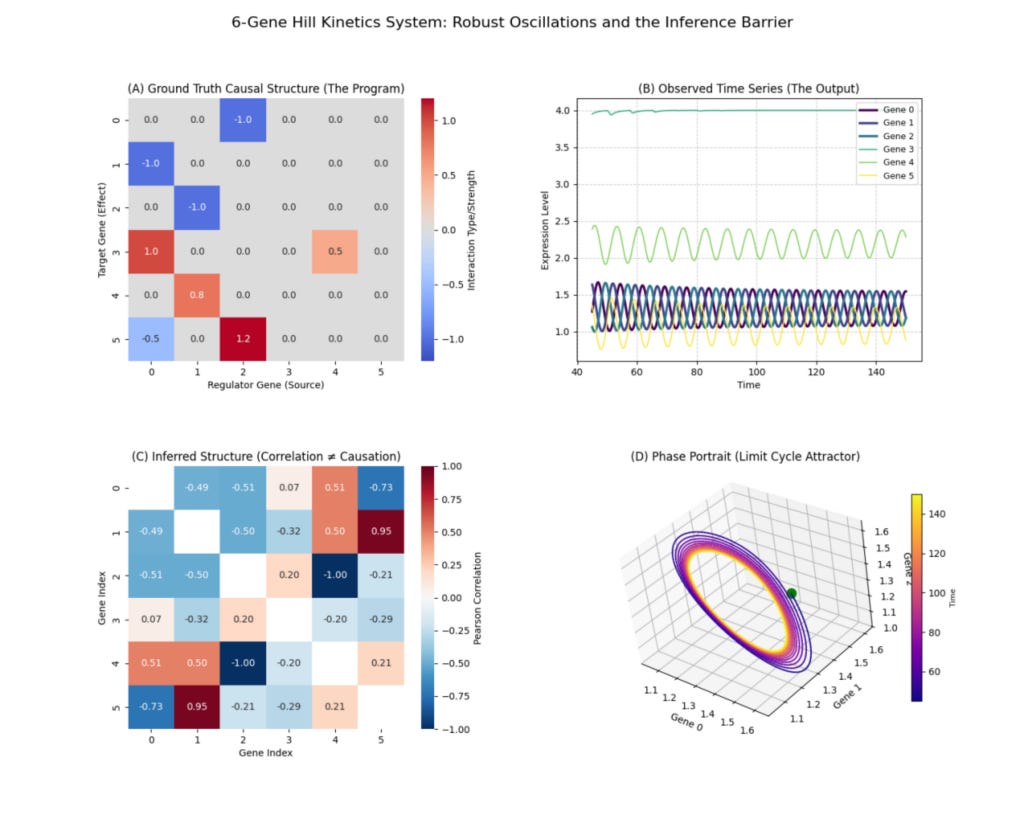
The Program (A): The “ground truth” causal structure is simple and known. The core is a three-gene “repressilator” (Genes 0, 1, 2): 0 represses 1, 1 represses 2, and 2 represses 0. This cyclic inhibition is an engine for oscillation. The system’s rules are non-linear Hill kinetics, a standard model for the switch-like behavior of genes.
The Output (B & D): This simple program generates a complex but stable output. The time series (B) shows robust, sustained oscillations. The 3D phase portrait (D) reveals the system settling onto a “limit cycle attractor”: a stable, predictable orbit whose structure reflects the dynamics.
The Inference (C): This is the critical point. If we are biologists who can only observe the output (B) and try to reverse-engineer the program (A) using a standard method like Pearson correlation, we get the map in (C).
This inferred structure (C) looks nothing like the ground truth program (A). For example, it infers a strong negative correlation between Gene 0 and Gene 2, but in the true program, they are not directly connected. Their relationship is mediated by Gene 1.
This is the Inference Barrier. The system’s own complex, non-linear dynamics obscure its simple underlying causal rules. Standard inference techniques fail (and yes, you can argue that your method would never have this property, but go with me here), confusing correlation with causation. If this happens in a tiny, 6-gene system, imagine the challenge in a real cell with thousands of components.
The Liver Cell and the model
Now let’s return to our liver cell. Asking for “the equation of a hepatocyte” is like asking for the “source code of a tornado”. Yes, there are underlying rules (the genome, biophysics), but the functioning cell we observe is an emergent property of those rules playing out within an irreducible, high-dimensional context. The shortest faithful description is the process itself.
So, what happens when we train a neural network (NN) on this system? The model excels at learning the statistical nature of the output. It becomes a powerful predictive mimic. But this mimicry is not understanding.
The AI’s success is complicated by two other biological truths:
Underdetermination (The Rashomon Effect): For any complex, finite dataset, there are multiple (perhaps infinite) distinct causal models that could have produced it.
Degeneracy: Evolution selects for function, not simplicity or interpretability. This means multiple, structurally different mechanisms can achieve the same functional outcome. Because of underdetermination and degeneracy, inductive inference (like ML) cannot guarantee convergence on the true minimal program. The AI will find a model M that fits the data, but M may not equal Pmin. This leads to a profound trap: when we use “Interpretable AI” (XAI) to understand the NN, we are merely revealing the logic of the mimic, not the logic of the organism.
Biological complexity and control theory
This idea is not a retreat from science; it’s a “shift in approach”. I think we must accept that the grand, unified “Newtonian moment” for biology may never come.
Our future lies not in completely reverse-engineering the cell, but in becoming “Biological Engineers” using a form of cellular control theory on systems we can never fully understand. We must shift our goal from understanding (in the classical, closed-form sense) to capability. We can still optimize and steer these systems (cellular control theory), even if their full logic remains beyond our grasp.
So what does this mean?:
Control without full understanding is viable. We can use short-horizon predictors and closed-loop experiments to keep biomarkers in range or optimize drug combinations, even if we can’t write the “true” small law underneath. Mechanism isn’t guaranteed. The neat cartoons and causal graphs that work for simple, reducible pathways may break on real tissues that adapt and rewire. The unit of progress is the experiment-in-the-loop. We must treat cells and organisms less like static equations to be solved and more like evolving programs to be tested, steered, and safety-bounded.
We are building “handles and levers,” not finding “laws.” Our AI mimics, validated by intervention, are the handles we use to steer these complex systems safely, ethically, and measurably. Achieving the goal of preventing disease and extending healthy life.
Open Research Questions
If you accept this idea, then new research questions open up. We must move from asking “What is the true model?” to “What is the limit of our knowledge, and how can we build reliable controls within that limit?”.
I’ve grouped some of my open research questions into some themes. Maybe some of these are well known, I’d appreciate a discussion. I don’t think this is a Hilbert Program for biology, but these seem like good things to know.
Theoretical Foundations
Quantifying Complexity: How can we develop practical metrics to quantify the degree of computational irreducibility, logical depth, and degeneracy in specific biological networks (GRNs, metabolic networks)? Can we operationalize “irreducibility” via computable surrogates (e.g., Lempel-Ziv complexity, permutation entropy, finite-time Lyapunov exponents) that predict the failure of equation discovery?
The Role of Modularity: How does biological modularity mitigate global irreducibility? Are the interfaces between modules the primary source of system-level complexity?
Evolution and the Edge of Chaos: Does natural selection actively drive systems towards regimes of high complexity or the “edge of chaos” because it provides functional advantages (e.g., plasticity, robustness)? We see this in the brain for example. Are there in vivo chaotic gene or cell-state oscillators in mammalian tissues, and can we estimate their Lyapunov spectra from longitudinal single-cell data?
Embodied Computation: How do the physical constraints and stochasticity of the cellular environment (the “analog” aspect) shape the computation, and can this be leveraged for inference?
AI, Modeling, and Experimental Design
The Limits of Causal Inference: Can we formally prove the limits of causal structure discovery algorithms when applied to data generated by computationally irreducible or chaotic processes?
The Status of Interpretability: If the true system is irreducible, what is the theoretical status of an “interpretable” AI model? Is it merely a human-centric simplification that necessarily misses the fundamental causality? Do mechanistic “attribution maps” from foundation models stabilize across retrains/datasets, or is their instability correlated with the complexity of the underlying dynamics?
The Engineering Paradigm: How do we develop a rigorous framework for the control of biological systems (e.g., using control theory) when the underlying minimal model is inaccessible?
Observability vs. Identifiability: What minimal sensor sets (modalities and sampling rates) are needed to cross the phase boundary from a non-identifiable to an identifiable model for standard pathway classes?
Experimental Halting Problems: Can we derive information-theoretic lower bounds on the number of experiments or perturbation complexity required to definitively decide membership in a model class (e.g., cooperative vs. competitive feedback), analogous to a halting-style hardness problem?
Appendix B: Right for the Wrong Reasons
Originally published October 30, 2025, by Kim Branson (original LinkedIn post).
I previously described how the complexity of biological systems often makes learning from data a model of the true causal mechanisms intractable. This phenomenon, known as unidentifiability, seems at odds with the ability of modern machine learning (ML) methods to construct highly predictive models from high-throughput data. If it works in other domains why wouldn’t it work in biology?
The answer is that it does, but quite often we generate a model that is “Right for the Wrong Reasons”. A model that accurately predicts biological system behavior within observed conditions but does not know the true underlying biological reality.
I then mentioned how we should move from seeking to build perfect models to seeking to use these for control, which led to a lot of people asking, if the model is wrong how can you possibly use it to steer a biological system. This is an excellent question and like all good questions it has a bit of a nuanced answer.
There is a related discussion about control theory, but we can save that for another time. But rest assured the world is run (the more I learn about the world I’m amazed anything works ever) by models that are wrong, but used in control very carefully.
To explain what I mean by this I’ve created a simple example of a biochemical signaling pathway with hidden states to illustrate how predictive accuracy diverges from mechanistic truth.
The utility of the model is strongly linked (as others have commented) to the hierarchy of learnability. Related to this are the limitations of data acquisition, who hasn’t been challenged about “how do you know this expensive omics experiment will be useful” and “how many samples do you need” when you don’t have a model. (There are ways to do this, but we can discuss that at another time).
These wrong but useful models can be brittle under perturbation (i.e. drug intervention). They can be useful for control of a biological system, but their domain of applicability is strongly linked to predictions you wish to make.
The Simulation Framework and Model Structure
Let’s create a simulation of a biochemical signaling pathway.
The “True System” is a non-linear dynamic system modeled by Ordinary Differential Equations (ODEs). A Signal (S) activates a Receptor (R) to R. R promotes an intermediate Protein (P1), which in turn promotes the output Protein (P2). Crucially, P2 inhibits the activation of R, creating a negative feedback loop. The strength of this feedback is determined by a kinetic parameter (kfeedback); a lower value signifies stronger inhibition at lower concentrations of P2.
Experimental Constraint: We assume that R/R* and P1 are hidden (unmeasured). Maybe they are low abundance proteins or splice forms no one has looked at in detail. The initial Machine Learning (ML) model (a Neural Network) is trained only on the observable Input (S) and Output (P2).
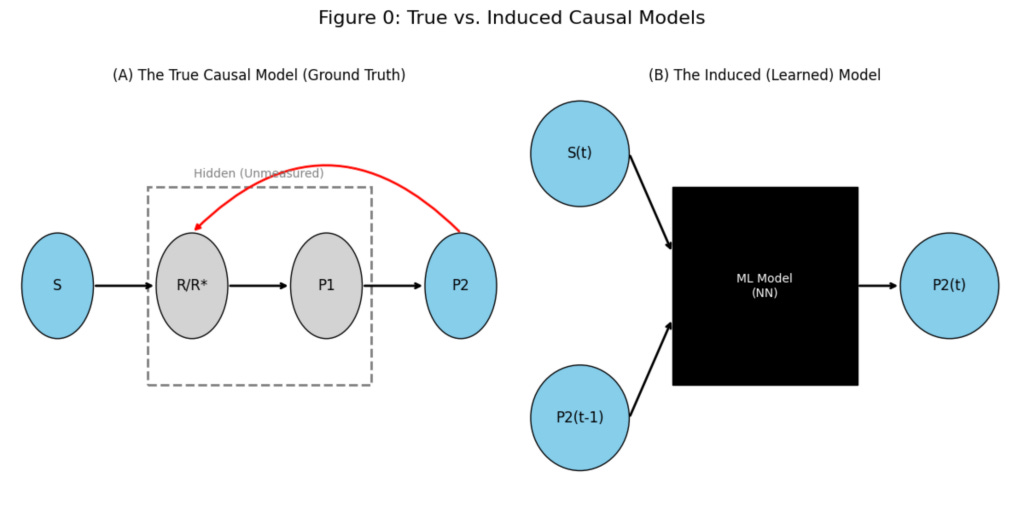
The True Causal Model: This is the ground truth, featuring a multi-step cascade and regulatory feedback (red inhibition arrow). The components in the grey dashed area are hidden from the observer.
The Induced (Learned) Model: This is the structure the ML model builds. It learns that the current output P2(t) is a function of the current input S(t) and the previous output P2(t − 1). It is a “Black Box” that completely bypasses the internal machinery (P1, R/R*) and the implicit feedback loop.
For our grumpy Biologist/Physician, the ML model has drastically oversimplified the biology (feel free to roll your eyes). It learned an association between the input (e.g., growth factor) and the output (e.g., proliferation) but missed the mechanism entirely. It is a model of system behavior not a model of the generative machinery.
So our learned model will be ‘wrong’. It doesn’t know about the core internals. But can it be useful?
Predictive Accuracy
Flexible function approximators, like Neural Networks, have the ability to learn complex input-output mappings even when the model structure is misspecified.
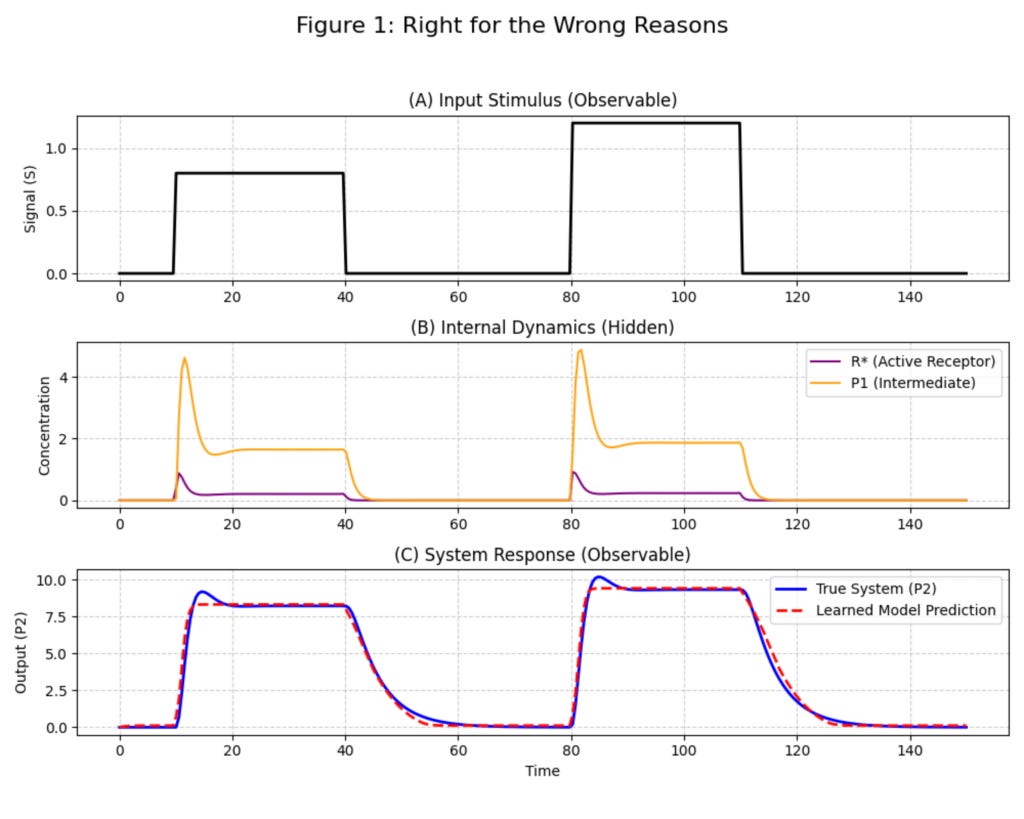
(Figure 1): We apply a complex input stimulus (A). The True System processes this through its hidden internal dynamics (B). When observing the output (C), the Learned Model (red dashed line) tracks the True System (blue solid line) reasonably well.
The ML model optimizes its parameters to minimize prediction error on the observed data manifold. You might be pretty excited if you could get this result. It successfully learns the correlation between S and P2 but fails to capture the underlying causal structure (the ODEs). This is a case of model misspecification.
The model is “Right” about the outcome under normal conditions, but for the “Wrong Reasons” because it does not understand the underlying biological machinery.
If we wanted to use this model to control a cell to produce a certain level of the protein, would it be good enough for this?
The Hierarchy of Modeling
This illustrates the Hierarchy of Learnability. We must acknowledge that biological systems may only be learnable up to a certain level (see Appendix A for some reasons why this is the case).
Level 1: Topology and Directionality (High Level): The model correctly learned that S affects P2, and the direction is positive. At this coarse-grained level, the model is correct.
Level 2: Dynamics and Functional Form (Mid Level): The model approximated the dynamics within the observed range but missed the precise mathematical relationships governed by the hidden states and feedback (e.g., saturation points, oscillation potential).
Level 3: Parameters/Kinetics (Low Level): The model is entirely ignorant of the true kinetic parameters. These are often non-identifiable due to redundancy and “sloppiness” (many parameters having little effect on the output).
A Data Acquisition Dilemma
A critical challenge in biology is determining optimal data sampling strategies. How much data is sufficient? Which data should you measure? Is RNA seq really all you need? Is the assumption RNA == protein good enough or do you need to consider RNA half life, transcription rates, codon usage, splicing, ribozyme assembly and splicing, protein translocation and turn over? And how many samples do you need? And what time frequency should you measure at? How to do this optimally with the budget you have. The list goes on. But don’t worry, there are ways to do this and again probably a good topic for another essay.
Luckily in simulation land we can do this. No planning or budget meetings needed. I analyzed the model’s performance as the amount of training data increased.
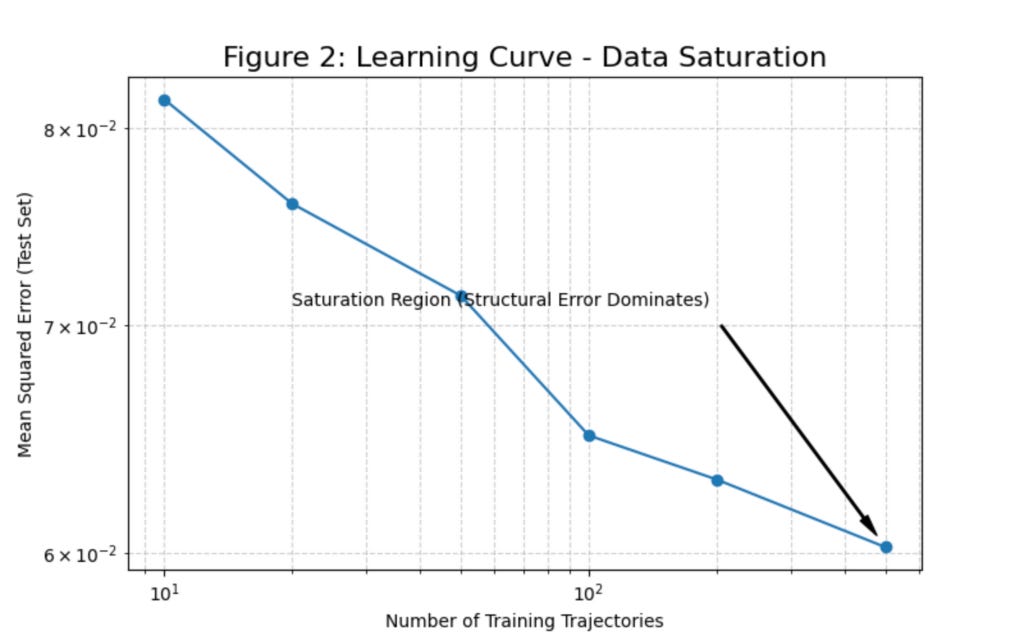
(Figure 2): The learning curve demonstrates diminishing returns. The model error decreases with more data but eventually plateaus.
The plateau indicates that the model error is now dominated by factors other than sample size, primarily Structural Error (the absence of hidden states R* and P1 in the model formulation) and irreducible noise. Collecting more data of the same type (passive observation) will not resolve the structural error.
Beyond the saturation point, more observational data won’t uncover the hidden mechanisms. Meaningful improvement requires active strategies like Optimal Experimental Design (OED), involving targeted perturbations, rather than simply collecting more of the same data. These actually use the model to guide the experiment.
Perturbations and Model Falsification
The utility of a model is best evaluated by its ability to predict outcomes under novel perturbations. This is the distinction between interpolation and extrapolation.
I simulated a structural perturbation: a 5-fold increase in the degradation rate of the hidden intermediate P1 (e.g., a drug that destabilizes P1, protacs for the win!).
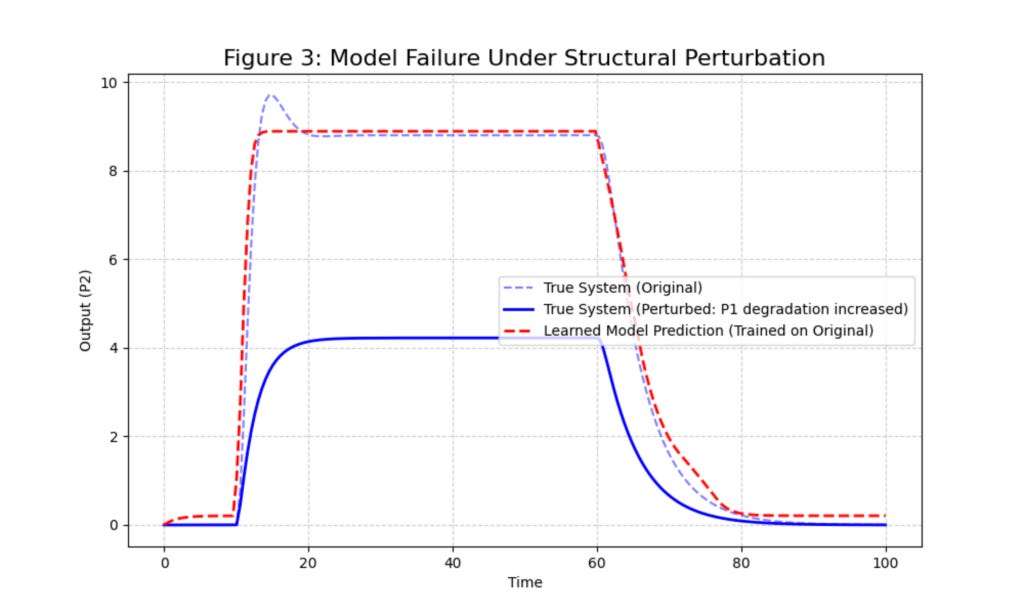
(Figure 3): When the degradation rate of the hidden intermediate P1 is increased, the True System’s response is attenuated (solid blue line). The Learned Model (red dashed line), unaware of P1, drastically overestimates the response.
The ML model fails because the perturbation induces a significant distribution shift, altering the data-generating process itself. Models trained purely on correlations lack robustness to such shifts. The model cannot extrapolate Out-Of-Distribution (OOD) when the underlying mechanism is fundamentally changed.
This is analogous to drug resistance. If a biological system changes its underlying mechanism (e.g., a mutation), a model that didn’t account for that mechanism will fail.
The Nuances of Control with Imperfect Models
If a model is predictive, it is tempting to use it for control, e.g., determining the optimal input (dose) to achieve a desired output (response). The success of this endeavor is highly dependent on where we attempt to exert control and whether the model correctly captures the system’s underlying structure, especially its non-linearities.
To illustrate this clearly, we utilize a “pedagogical” Learned Model. (I originally did this with the model I had trained before, but errors of 0.18 vs. 0.063 don’t seem that bad to a biologist.) This model is constructed to perfectly match the True System within a specific “training range” (S < 0.1, indicated by the gray shaded area), but linearly extrapolates behavior outside this range, completely missing the True System’s saturation point. Think of this as data points that we didn’t collect in an experiment so our model is poorly behaved outside this region.
Control involves solving an inverse problem. The True System (blue line) saturates due to negative feedback. The Learned Model (red dashed line) matches the True System perfectly in the sensitive region but then diverges dramatically, failing to capture the saturation. This represents a model that is locally accurate but globally misspecified.
Let’s examine two scenarios using this flawed Learned Model.
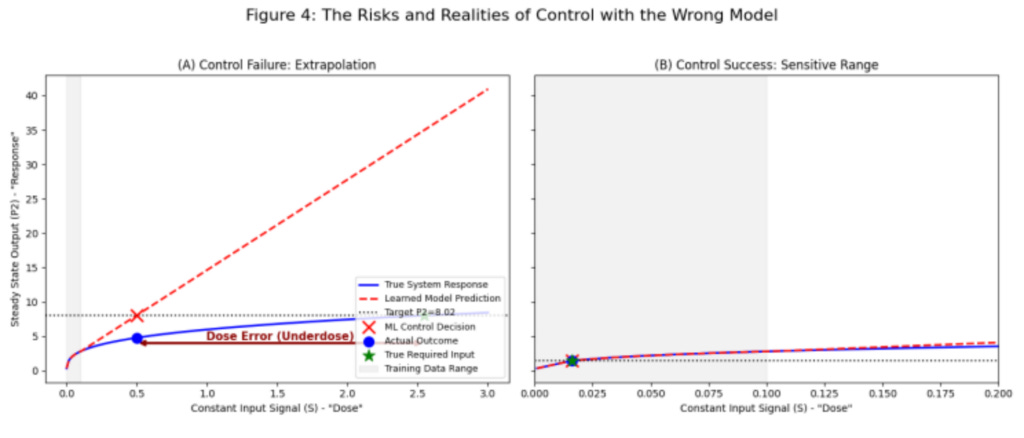
Scenario A: Control Failure (Original Figure 4A)
In Figure 4A, we aimed for a target P2 level of 8.015, which is near the saturation point and far outside the model’s training range.
To achieve the target of 8.015, the True System actually requires a high input S ≈ 2.548 (Green Star).
The ML model, based on its flawed linear extrapolation, mistakenly suggests a much lower input S ≈ 0.498 (Red X). It believes the system is much more sensitive than it truly is.
Applying the ML-suggested input to the True System results in only P2 ≈ 4.781 (Blue Circle).
The control failed dramatically (Output Error: 3.234). The model suggested a dose that was 80% too low.
This represents a significant Undertreatment failure. The model failed to understand the resistance (feedback) inherent in the system, leading it to recommend a dose insufficient to achieve the therapeutic goal. The model was wrong precisely because it extrapolated behavior from the sensitive region into the saturated region.
Scenario B: Control Success (Original Figure 4B)
In Figure 4B, we aimed for a lower target P2 level of 1.5. This target lies within the sensitive region where the model was “trained” (the gray shaded area).
The True System requires an input S ≈ 0.016 (Green Star).
The ML model correctly suggests the input S ≈ 0.016 (Red X).
Applying this input results in P2 ≈ 1.448 (Blue Circle).
The control was successful (Output Error: 0.052). In this region, the Learned Model’s behavior matches the True System.
The Utility and the Caveat
This demonstrates a critical lesson: A “wrong” model can still be useful (Scenario B) if it is used strictly within the bounds of its known accuracy (interpolation).
However, the utility is strictly bounded. When the context shifts outside the training data (extrapolation), the model’s structural flaws become apparent, leading to significant failures (Scenario A). The danger is that we often do not know the boundaries of a model’s accuracy until we test them, and relying on a flawed model for critical interventions remains inherently risky.
Intervention and Model Improvement
The Black Box model (Figure 0.B) only understands manipulating S. It is blind to internal targets like P1 or the feedback loop. It cannot predict the outcome of a drug targeting these components.
Perturbation of P1
Let’s simulate a strong intervention: highly stabilizing P1 (e.g., a drug that reduces P1’s degradation rate by 90%). This should significantly increase the output P2.
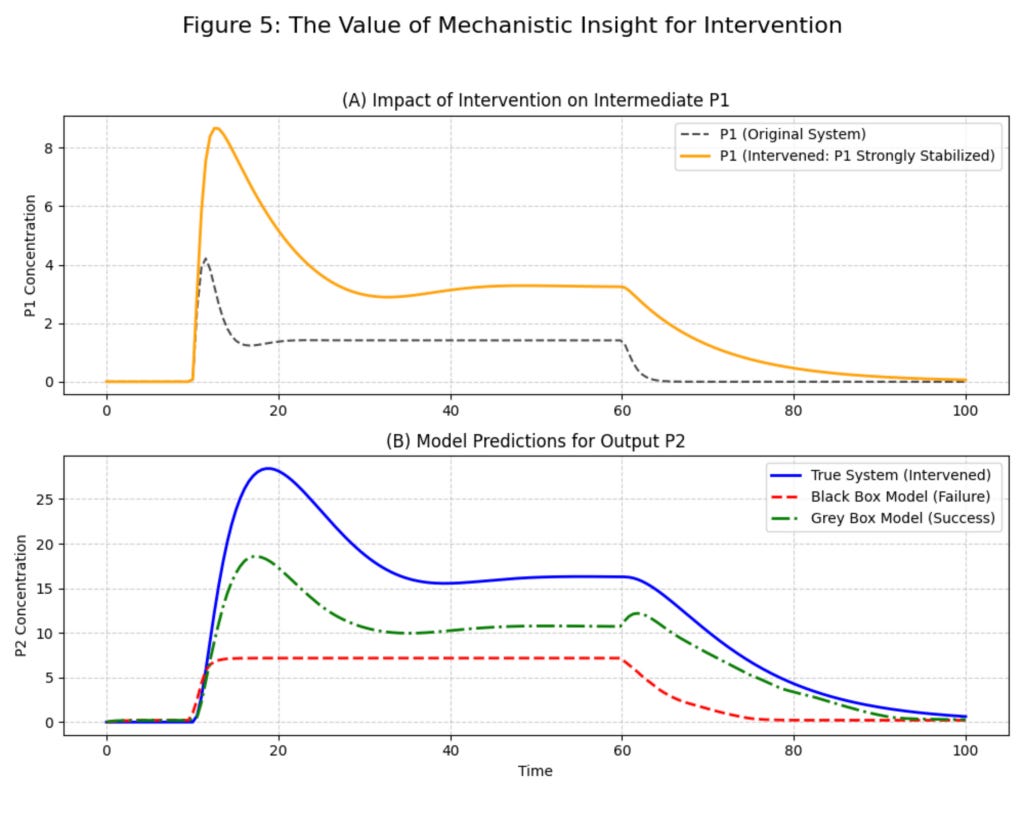
(Figure 5): The intervention causes P1 to rise dramatically (Panel A, orange line), leading to a large increase in the True System’s output P2 (Panel B, blue solid line). The Black Box model (red dashed line) fails completely to predict this change, significantly underestimating the response because it assumes the original dynamics remain valid.
Introducing the Grey Box Model
What if we developed a new experimental assay to measure P1, and we observed that patients with a severe form of disease, or earlier onset, had increased P1? We can incorporate this data and update our model, moving to a “Grey Box.” The New Induced Structure: P2(t) is now learned as a function of S(t), P2(t − 1), and P1(t − 1).
(Figure 5, Grey Box Success): The Improved (Grey Box) Model (green dash-dot line) successfully predicts the behavior of the intervened system.
The Grey Box Model has learned the causal link P1 → P2. When it observes the elevated levels of P1 (resulting from the drug intervention), it correctly predicts the corresponding elevation in P2. By measuring P1, we descended the Hierarchy of Learnability, gaining crucial insight into the system’s functional form (Level 2).
Discovering and measuring a key component of the system (P1) allows us to build vastly superior models. If we need to intervene in a biological component then we will need to model it at the Level 2 definition to understand the intervention.
This does not mean we need to model all components at the same level. The inputs to this system might be fine at the higher input level. We might be able to model the system that produces S as a simple model, or the downstream effects of P2 on organ function. There are methods that allow us to build control systems that have connected and varying levels of detail, with some components at higher levels connected to lower levels. Again there is a wealth of tools from control theory that can be applied here.
So useful then?
Biology is optimized by evolution for function, not for mechanistic elegance. Evolution selects for outcomes; it “just sees the results and not how it gets there.” I think this is where it’s customary to add the George Box quote everyone uses, “all models are wrong, but some are useful.”
Being “Right for the Wrong Reasons” is often a necessity when the ground truth is inaccessible. However, the utility of these models is strictly bounded. While they may suffice for prognosis or interpolation within known conditions (Figure 1, Figure 4B), our simulations demonstrate their brittleness under structural perturbation (Figure 3) and their significant risks when used for control outside their validated range (Figure 4A).
The critical insight here is that prediction is not control.
While the advancement of AI in biology is undeniable, if our goal is to actively steer and control biological systems, such as directing cell fate, optimizing complex therapies, or counteracting disease progression, we must design our experiments and models specifically for that purpose.
Current powerful predictive tools, such as sophisticated single-cell ML models that forecast transcriptional responses to drugs (e.g., insert your favorite from the arxiv here), are generally “open-loop.” They answer the question: “If I push here, what happens?”
True control requires a “closed-loop” approach, where the model continuously adjusts interventions based on real-time feedback from the system. This approach can stabilize and steer biology despite inevitable model errors, but it demands a shift in strategy.
Active Experimentation (Identification-for-Control): We must move beyond passive observation. Experiments should be designed not just to map the entire system, but to actively perturb it and learn the specific dynamics essential for the control task. Data collection stops when the model is “good enough” for the intended intervention, not when we achieve arbitrary predictive accuracy.
Robust Design: Controllers must be designed with “robust margins,” safety buffers explicitly calculated to account for the gap between the model and biological reality.
Safety Constraints: Implementing advanced techniques ensures the system remains within safe operational envelopes even during exploration. For example, integrating safety constraints (like Control Barrier Functions) with optimization-based control (like Model Predictive Control) [which is annoyingly abbreviated the same as model context protocol and this is going to cause a lot of confusion in the future] allows for effective steering while respecting biological limits.
Hierarchical Modeling: Rather than attempting to build a perfect, monolithic model of the entire cell, control often exploits hierarchy, focusing on simpler, local surrogate models that are sufficient for the task at hand.
This closed-loop framework allows us to reliably steer a system even if the underlying virtual model is imperfect because the feedback mechanisms and safety constraints actively manage and absorb the errors.
The future of AI in biology lies in this synergy between data-driven modeling and strategic, control-oriented experimental design. It requires moving iteratively from Black Boxes toward Grey Boxes (Figure 5) using directed data to refine hypotheses and targeted perturbations to falsify models, iteratively descending the hierarchy of learnability.
Ultimately, even the decision of which parts of the system can remain Black Boxes and which require Grey Box refinement can itself be learned (meta learning!), optimizing our path toward functional control of biological systems.